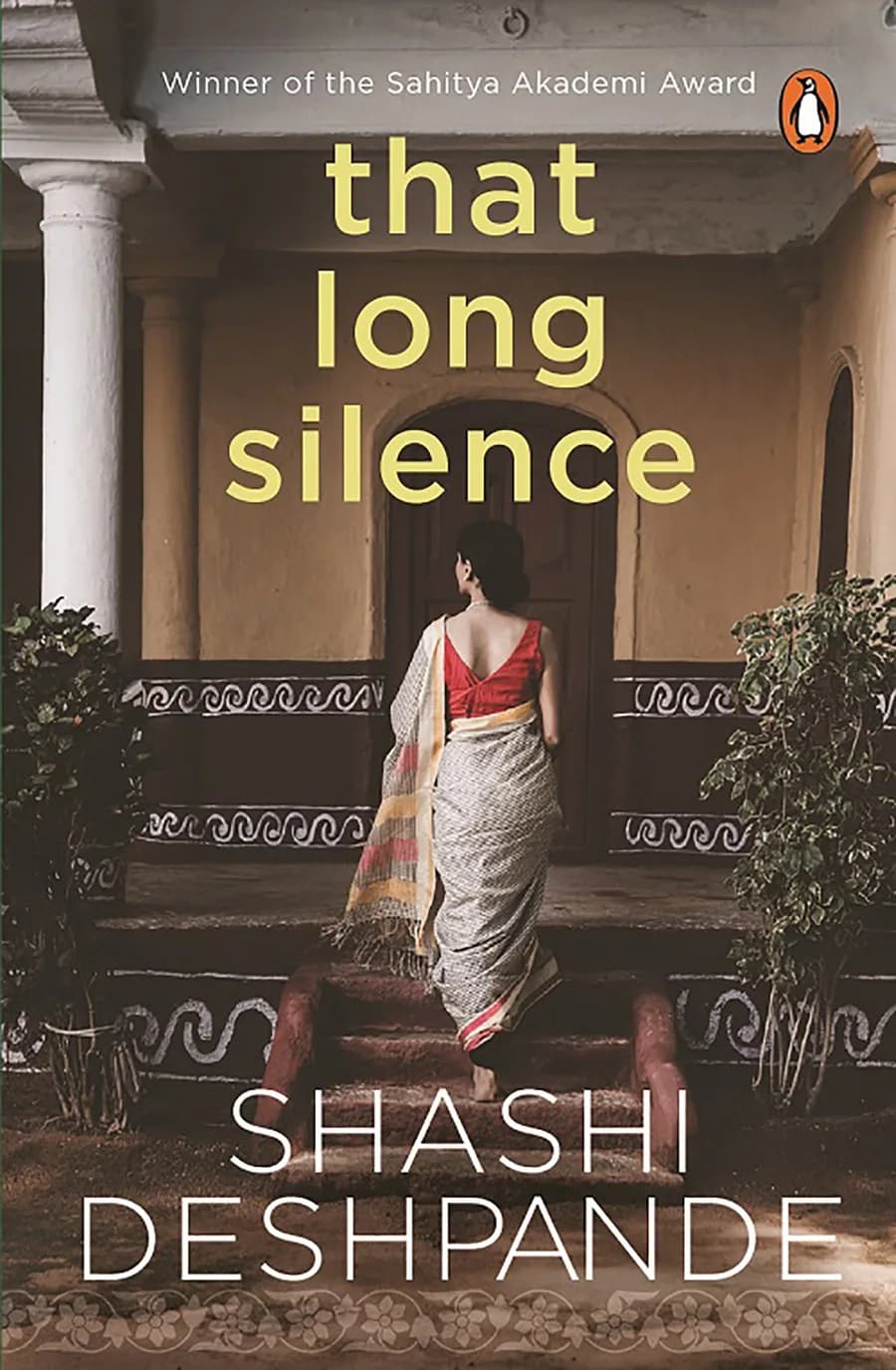
That Long Silence by Shashi Deshpande
The Vocabulary of Silence
Reflections on Shashi Deshpande's That Long Silence
Shrikant Pandey
From the start of this year, I have been prioritising quality Indian literature over world literature. As a matter of fact, except for Vladimir Nabokov’s Bend Sinister, all the books I have read this year belong to the Indian literary landscape. When selecting my next read, I find it expedient and safe to check the list of Sahitya Akademi Award winners.
This is how I discovered That Long Silence by Shashi Deshpande and promptly ordered its Penguin paperback edition. First published in the UK in 1988 and in India the following year, this short novel of 193 pages won the Sahitya Akademi Award in 1990. I had started it in the first week of September and it took me about two weeks to complete. Overall, I found it remarkably insightful in examining the quiet, unexpressed undercurrents of domestic life, the breakdown of honest communication, traditional expectations, and the personal compromises individuals make. I have no hesitation in declaring that it proved to be a profound choice.
This is Shashi Deshpande’s fifth novel; her other notable works include A Matter of Time (1996) and Shadow Play (2014). Most of her novels deal with the delicacy of relationships that give life its meaning. A Padma Shri awardee (2009) and the author of eleven novels alongside several short story collections, Deshpande (born 1938) is frequently described as a feminist writer, mainly because she gives centre stage to her female protagonists. I would simply say that Shashi Deshpande is a good writer.
In essence, That Long Silence is the story of an urban, middle-class woman named Jaya Kulkarni. The narrative spans her memories from the years around India’s Independence, with the central crisis taking place in the 1970s. Born in a small place called Saptagiri, she spent her childhood there and her adolescent years in Ambegaon near Pune. As a young girl, Jaya is clever, curious, and bright, qualities encouraged by her father but frowned upon by her mother, grandmother, and other women in the family who want her to act conventionally. Eventually, Jaya learns to play the traditional female role and marries Mohan, an engineer.
Jaya and Mohan disagree on many things, and their marriage lacks genuine intimacy or happiness. There is no room in the relationship for Jaya to express her point of view, as Mohan expects her to go along with everything he says. Though she wishes for emotional and physical closeness, Mohan—while happy to have an English-educated, intelligent, and presentable wife. He never cares to connect with her deeply. Jaya, too, finds herself unable to voice her feelings and thoughts. This is the beginning of "that long silence" for her. As she graduates into motherhood and her scope of responsibility expands, the range of her silence expands along with it.
Jaya becomes a dutiful, sacrificing wife, a caring mother, and a compassionate relative—in short, a duty-bound, subservient woman who neglects her own inclinations. Yet, unlike most women around her, she retains a sharp sense of individuality. She writes in her free time, though she has failed to become a commercially successful author. Jaya is acutely aware that people generally dislike it when she expresses her true self, so she learns to hide it. During her youth, only her father encouraged her; later, it was her neighbour Mr. Kamath, a lonely, compassionate man with artistic inclinations. When Mohan is suspended from his job for financial impropriety, the couple retreats to a small flat in Mumbai, prompting Jaya to think deeply while enduring claustrophobic and neurotic experiences. She hits a breaking point: her teenage son Rahul has run away while on vacation with family friends, and Mohan leaves the house for a few days after an altercation. These events shake her to the core. Terrified that the status quo will shatter, her mind goes into overdrive, replaying the past and dreading the future. It all happens internally. She obsesses over what happened, what didn’t happen, what could, should, or might happen. In a matter of days, she reviews her entire life, parsing her relationships with every family member and examining how she hides behind the veil of a wife and writer. By the end, she realizes that remaining silent and suppressing her inclinations was ultimately her own choice, not something entirely imposed by others. The book ends with Mohan sending a telegram saying he will return soon and that his job is secure. Jaya prepares to accept him back, vowing never again to let a long silence separate them emotionally.
There is not much plot to the story; in fact, it is only a mild exaggeration to say it isn't a story in the traditional sense. Instead, it is a series of intense monologues happening inside the protagonist's mind. Her story reflects not only her own dilemmas but the silent difficulties of women across different generations and socio-economic backgrounds.
Through the behaviour of these women, cutting across three generations, a very uncomfortable thought gripped me, one I am unable to shake off. The anger, desolation, and grudge against patriarchal systems exist in isolation; each woman experiences it alone, even though they all face the same weight. Ironically, the very women who consider themselves victims of an unjust patriarchal system unceasingly become its tools. They transition from victims to active participants and perpetrators. A woman who wants equal opportunity and absolute dignity for herself will readily castigate another for a transgression defined by the very system she fights if doing so secures her own social acceptance.
I found a few elements in the narrative disturbingly desolate, yet highly instructive and ironic:
The Mother's Spite: Immediately after the death of Jaya’s father, her mother sells their home in Saptagiri and moves the family to her parents' place in Ambegaon. The children lose both their father and their home. This wasn’t done for convenience or financial survival; it was done out of spite for her late husband and his family. His death presented a delayed opportunity to give full expression to long-stifled emotions. The long silence turned into something spiteful and treacherous. Furthermore, her loud, public wailings at his death were performative rather than deeply felt. She remained silent when she should have put her foot down in life; once freed by his death, she became dominant and controlling. Ironically, she cried and wailed simply because society expected her to perform, even while taking swift action to obliterate his memory by abandoning their home.
Mohan's Hurt: Mohan gets deeply hurt—not angry but seriously hurt—when Jaya wins a prize for one of her stories. The man who constantly proclaims that all his hard work and labour are solely for Jaya and their children cannot stomach her independent success. Her craft means nothing to him; he is overwhelmed by the fear that the story exposes their own conjugal life and will make him a talking point among their peers. Convincing himself that Jaya wrote it out of malice, his reaction forces her to stop writing evocative literature. Instead, she becomes a columnist, writing harmless, useless pieces under the pen name "Seeta." It made me wonder whether anger, unlike hurt, can sometimes serve a purpose. Anger may provoke action; hurt often does nothing but settle into a swelling, silent grudge.
Instinctive puritanism: Jaya shares intellectual bonding with her neighbor, Mr. Kamath. They talk about writing and Jaya receives guidance and suggestions from Mr. Kamath. However, there is something about Jaya's relationship with Kamath that disturbed me. Jaya is not easy with him and very conscious of his presence, his gaze, though Mr. Kamath's conduct is very friendly and beyond reproach. Jaya is unable to define her relationship with Mr. Kamath. Why must every relationship between a man and a woman be given a name or fitted into an accepted social category? Their relationship was asexual, intellectual and mutually fulfilling, yet Jaya could never be entirely comfortable with it. The guilt ran so deep that even death could not free her from it. Must emotional/intellectual intimacy between a man and a woman necessarily be either conjugal, sexual, familial, or illicit? Is there no legitimate space in between?
The Abandonment of Mr. Kamath: Jaya’s failure to visit Mr. Kamath in his final moments, and her decision to spend only a few minutes in his flat after his death, is perhaps the most poignant and disturbing passage in the novel. Her overriding concern is to avoid a single blemish on her status as a devoted wife. The fact that Kamath was the only one who encouraged her writing, helped her get published, and connected with her intellectually and emotionally meant nothing in the end. Compassion, empathy, and genuine affection were completely subservient to her projected image. To disown such a vital human connection in the face of death for something as fleeting as "what will my husband think?" is desolate beyond words. Jaya returns home agitated, unable to eat or bathe, but gradually loses herself in household chores. Within hours, she manages to conquer her guilt. In the evening, she takes a long hot bath, dines with her family, and wraps up the day by initiating physical intimacy with her husband to completely erase the lingering unease. It is the ultimate escape from guilt. Yet, the memory returns to haunt her in a state of feverish delirium after Mohan leaves. She could not have saved Kamath, but walking away from a dead body reveals the disturbing depths to which human sensitivity can fall. What makes it terrifying is that Jaya is not an unfeeling woman; she is conscientious and sensitive. Her later conversation with her widowed neighbour Mukta—who stoically sits by Jaya's bed during her 104-degree fever, brings her face to face with this uncomfortable past. The conversation also highlights a stark contrast between the two women, making Mukta the most genuinely compassionate character in the story.
The novel describes the social milieu of the 1970s, and while the societal status of women has shifted since then, marital incompatibility and the lack of emotional congeniality remain ageless issues. A silence kept for fear of being misunderstood or used to guard oneself against the treachery of one's own mind achieves precious little. It merely ensures an edited version of one's desires to maintain an uneasy peace. The cost is incredibly high: it destroys the chance of achieving genuine compatibility, a relationship where two people converse easily, completely free from the fear of judgment or psychological manipulation.
Admittedly, I found the writing style a bit confusing at times. Deshpande jumps at the speed of thought, shifting rapidly between places and time periods, which can disorient the reader. Then again, a wandering mind is a very real thing, so one cannot be overly critical of this technique.
The Times Literary Supplement found the novel's strength in its “compassion, its tolerance and understanding of human relationships”. I came away with a somewhat different feeling. There are certainly flashes of empathy, but what stayed with me was its desolation and angst: the sense of a silence that does not merely remain, but quietly, continuously gnaws.
These are the passages I carried away from the book.
Excerpt-1 (Page 116)
Each relationship evolves its own vocabulary. Ours had been that of the workaday world. The vocabulary of love, which I had thought would come to us naturally and inevitably, had passed us by; so too had the vocabulary of anger. No, it was I who had left that alone after the day when my first disastrous foray into verbalising emotions had almost ripped our marriage apart. Since then, we'd never gone beyond those first basic mudras. Now suddenly, unfairly, he'd overtaken me. His fingers flickered, creating images, not of beauty, but of darkness and deceit.
Excerpt-2 (Page 132)
'The relation of man to woman is the most natural of one person to another.'
Karl Marx - yes, Karl Marx it was who'd said that. Natural? When we are forever hurting, forever wronging each other? Natural? When we're forever resenting our need of each other? How wrong you were about this, Mr. Marx, prophetically right though you may have been about so much else.
Excerpt-3 (Page 143 & 144)
'I gave up my writing because of you,' I said to Mohan, and he seemed astonished. Why didn't I speak then, why didn't I explain, why didn't I remind him of the day he had come back from work carrying a magazine he had thrust at me, saying, 'Your story is here.'
'My story?' Feverishly I had turned over the pages and stared at my name, entranced. Then I had turned to Mohan. 'Oh God, Mohan, I've won a prize, it's the story I sent for the contest, it's got a prize...'
Mohan's face had finally silenced my babble. 'Jaya,' he had said dully, 'how could you, how could you have done it?'
How could I have done what?
'They will all know now, all those people who read this and know us, they will know that these two persons are us, they will think I am this kind of a man, they will think I am this man. How can I look anyone in the face again? And you, how could you write these things, how could you write such ugly things, how will you face people after this?'
I had realised it then, even in the state I had been in, that he had not been angry, but hurt; he had looked as if I had wounded him.
'How can you reveal us, how can you reveal our lives to the world in this way?'
I had known then that it hadn't mattered to Mohan that I had written a good story, a story about a couple, a man who could not reach out to his wife except through her body. For Mohan it had mattered that people might think the couple was us, that the man was him. To Mohan, I had been no writer, only an exhibitionist.
Excerpt-4 (Page 153)
I could not escape the truth any longer. He was dead.
'Why don't you stay dead and leave me alone?'
'Leave you alone? Why, it's you who won't leave me alone, it's you who won't let me go!'
It's only with the dead that we can have a perfect relationship. There are no knots, no awkward tangles here. We can mould the dead to our desires, to suit our purposes. But this man - he resisted all my attempts to manipulate him, to manipulate our relationship. I could see him grinning at my discomfiture as I failed. And yet I knew I had to puzzle it out, to put the bits and pieces together and see what form it took, my relationship with this man.
It refused to take any shape at all; it just slipped about, frighteningly fluid. Perhaps the fact that for a long time, why, till the very end, I didn't know how to address him was significant. 'Everyone calls me just Kamat,' he had said to me, but I had never been able to address him that way. He, however, had called me Jaya right from the very first day. I had envied him the ease with which he had used my name, plunging into an intimacy that would have scared me off if he hadn't made it seem so natural, so asexual.
'Come and join me,' he had said that first day, when I had gone to him with his letter that had been wrongly delivered to us.
Excerpt-5 (Page 192 & 193)
Mohan will be back. 'All well' his telegram says. Does he mean by this that we will go back to being 'as we were'? Does it mean that, now that Mohan has sorted out his problem, and no longer fears prosecution, joblessness and disgrace, we can go back to our original positions? Does it mean that he will come back and give me a carefully edited version of what has happened - as he has done so often till now - and then ask me, 'What do you say, Jaya?'?
Until today, this has been a rhetorical question. I have looked at his face for clues and then given him the answer I know he wants. I have only to do this now and authority will seep into Mohan once more.
But it is no longer possible for me. If I have to plug that 'hole in the heart', I will have to speak, to listen, I will have to erase the silence between us. While studying Sanskrit drama, I'd learnt with a sense of outrage that its rigid rules did not permit women characters to speak Sanskrit. They had to use Prakrit - a language that had sounded to my ears like a baby's lisp. The anger I'd felt then comes back to me when I realise what I've been doing all these years. I have been speaking Prakrit myself.
But why am I making myself the heroine of this story? Why do I presume that the understanding is mine alone? Isn't it possible that Mohan too means something more by 'all well' than going back to where we were? People don't change, Mukta said. It is true. We don't change overnight. It's possible that we may not change even over long periods of time. But we can always hope. Without that, life would be impossible. And if there is anything I know now it is this: life has always to be made possible.