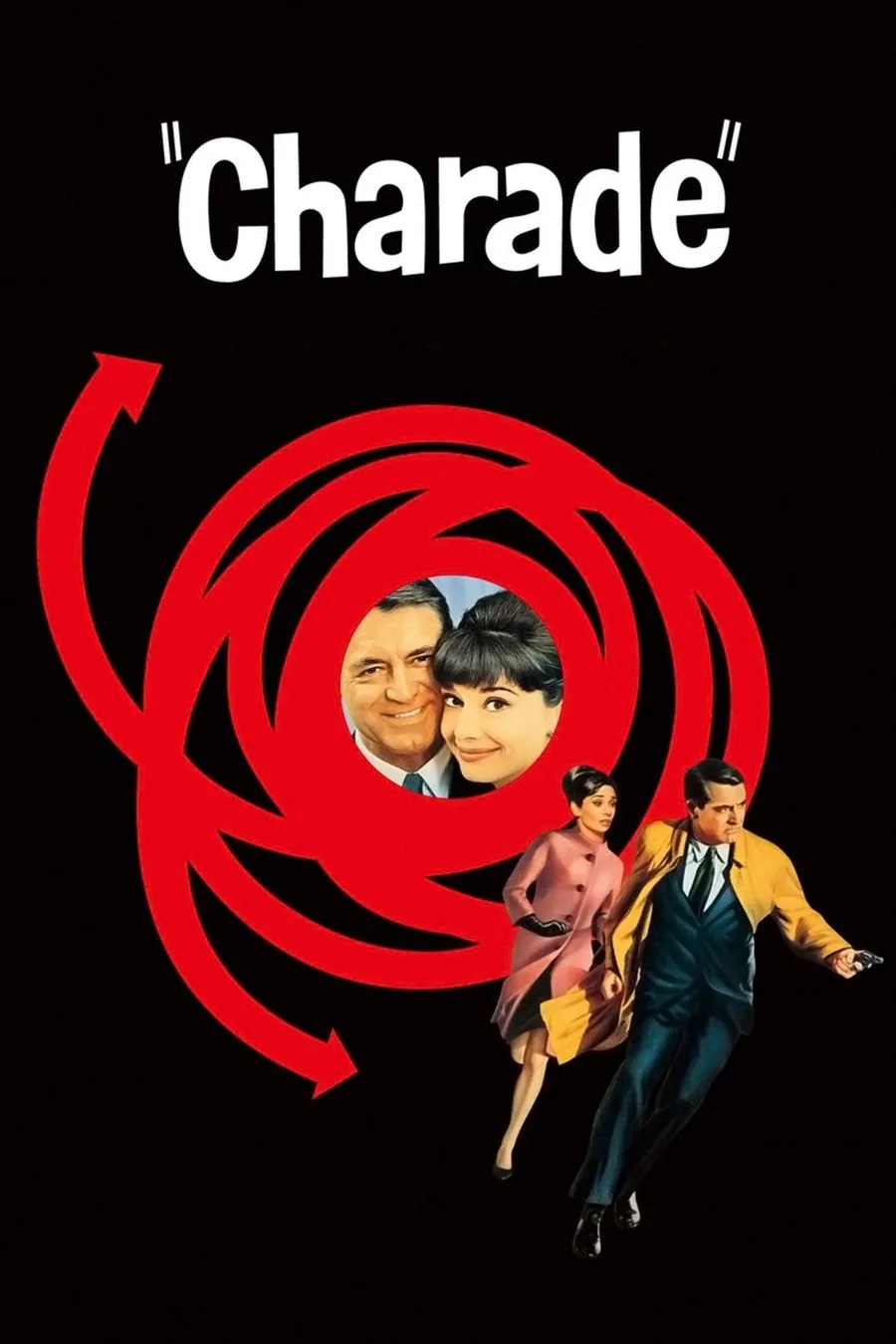
Charade dir. Stanley Donen
Stumbling Upon Charade: A Joyful, Breezy Ride Into 1960s Glamour
Review by Shrikant Pandey
Watched on YouTube | Runtime: 113 mins
Genre: Comedy, Mystery, Romance | Director: Stanley Donen
Cast: Cary Grant, Audrey Hepburn, Walter Matthau, James Coburn, George Kennedy, Jacques Marin

How We Stumbled Upon Charade
We watched Charade last Sunday purely by chance. It caught my attention while I was navigating through YouTube on our TV, looking for a light, breezy comedy. The previous week's back-to-back viewing of Nana Patekar's Krantiveer and Prahaar, though immensely rewarding, had also proved a bit heavy. The last thing we wanted was a film that made heavy social commentary or contained entrenched moralistic themes.
For some curious reason, the title on YouTube is not listed as Charade; instead, it is described as: “Mystery Comedy | Audrey Hepburn | A Paris Widow Hunted for a Missing Fortune,” with no mention of the film’s actual name. This was a minor curiosity, but it intrigued me enough to investigate the reason. I learned that the 1963 version of Charade entered the public domain immediately upon its release due to a production oversight. Universal Pictures completely omitted a proper copyright notice in the opening credits, losing legal protection under U.S. copyright laws at the time. Because the film print is legally free, YouTube is flooded with independent uploads carrying descriptive, search-friendly titles (e.g., "Romantic Mystery Thriller by Hitchcock" or "Full Comedy Film"), which are often upscaled to 4K or feature completely reconstructed trailers and titles. The version that we watched is one such example. That aside, the restored 4K version available on YouTube is beautifully reconstructed and hardly feels dated at all.
Audrey Hepburn Comes Home
Our daughter, Charu, was so enamoured of Hepburn during her teenage years that I bought a full-size poster of the legendary actor and fashion icon, framed it, and hung it in her room. The framed portrait is one of the most famous publicity stills of Audrey Hepburn playing Holly Golightly in the 1961 classic film Breakfast at Tiffany’s. It was shot by Paramount Pictures head photographer Bud Fraker in 1961 and designed by Hubert de Givenchy, featuring the iconic black evening dress, elbow-length gloves, multi-strand pearl necklace, tiara, and her signature long cigarette holder. This promotional portrait went on to become one of the most recognizable pop-culture images in cinema history and found its way into our home.

A Familiar Face at Home
Paris, Murder and Many Aliases
Before settling in to watch, a quick search revealed that Charade was a massive critical and commercial success, becoming one of the highest-grossing movies of 1963. Critics heavily praised its witty dialogue, fast-paced screenplay, and the unmatched chemistry of its leads. Intrigued, we made the decision to watch it immediately, a choice that left us with absolutely no regrets. Very few films in recent months have provided such a joyful ride. Driven by my usual curiosity, I spent hours after the film reading up on its cast, its initial reception, and the legacy it left behind. This review is the result of both watching the film and diving into those fascinating post-movie reads.
Equal parts rom-com, spy thriller, and Givenchy fashion showcase, Charade is Hollywood cinema’s frothiest romantic thriller at its absolute best. Mystery, murder, mayhem, and duplicity are all on the menu. Returning from a chic ski holiday in the French Alps, Regina Lampert (Audrey Hepburn) is looking to escape a loveless marriage. During the trip she meets the dashing Peter Joshua (Cary Grant), and their playful chemistry instantly crackles. Upon her return to Paris, she discovers that her husband, Charles, has been murdered. Soon, Reggie and Peter are being pursued by three of her late husband's World War II cronies: Tex (James Coburn), Scobie (George Kennedy), and Gideon (Ned Glass). The quartet had stolen a quarter of a million dollars while behind enemy lines during the war, and the men believe Reggie has the missing fortune. But a deeper mystery lingers: why does Peter keep changing his name?
As she pursues this dashing man of many aliases, Reggie finds herself capering around Paris, accidentally trapped in an embezzlement scheme where she must prove her innocence. Peter’s real identity is kept hidden until the final moment. As a smooth manipulator with a hint of convincing menace, Grant injects a persistent tension into his relationship with Reggie, even as their bond evolves into something bright and shimmering. The zig-zagging plot cleverly reveals multiple identities for both Grant and Walter Matthau’s characters, culminating in a brilliant resolution involving a rare stamp collection.

Chemistry to Spare: Regina Lampert and Peter Joshua
Hepburn and Grant: A Perfect Pairing
The film's overt silliness, bordering on a spoof at times, is grounded by Audrey Hepburn's wonderfully deadpan demeanour, making Charade endlessly engaging. The sight of Hepburn slinging barbed one-liners with increasing exasperation is worth savouring. Cary Grant matches her scene for scene, word for word, through rapid-fire repartee. One of the funniest and most endearing situations arises when Reggie coaxes Peter into bathing in her hotel room, declaring, “This is a ludicrous situation; I can think of a dozen men who are just longing to use my shower!” Peter playfully takes the bait and proceeds to take a shower fully clothed; his vaudeville routine is as absorbing as his soaked-through suit. Despite her classy wardrobe, Reggie is beautifully human—awkward, anxious, and occasionally clumsy, leading to a delightfully forced moment when she accidentally plunges an ice cream cone into Grant’s suit.

A Shower, Fully Clothed
Their flirtation is filled with subtle innuendo and humor from the very start. When Reggie first meets Peter, their exchange is lively:
“Is there a Mr. Lampert?” he asks.
“I’m getting a divorce,” she replies.
“Please, not on my account,” he quips.
The screenplay features numerous magnetic exchanges like this. I found myself chuckling at their witty philosophical detours, such as when Reggie asks, “Why do people have to tell lies?” and Peter responds, “Usually it's because they want something. They are afraid the truth won't get it for them.” Later, when Reggie admits, “I think I love you,” Grant's character replies, “You just said a horrible word... serious. When a man gets to be my age, that's the last word he ever wants to hear.”
Admittedly, the film contains more violence than one might expect from something so breezy and playful. The opening scene featuring Charles’ body being tossed from a moving train, the various corpses discovered along the way, and the breathless rooftop fight sequence between Grant and Scobie (featuring a nasty slash from Scobie’s hook) are not very pretty. When most of the film centers on Hepburn and Grant having a grand time together, these macabre details come as quite a shock. Yet, these moments of suspense are always masterfully offset by humor, usually driven by Hepburn’s irresistible reactions.

The Menacing Trio: Tex (James Coburn), Scobie (George Kennedy), and Gideon (Ned Glass)
An Ensemble to Remember
On top of the two leads, Charade boasts a stellar supporting cast. Walter Matthau is excellent as the deceptive CIA administrator Hamilton Bartholomew, while James Coburn, George Kennedy, and Ned Glass perfectly flesh out the shady wartime cronies.

Trust Him at Your Peril: Walter Matthau as Hamilton Bartholomew
Personally, I found the character of Inspector Édouard Grandpierre, played by the famous French character actor Jacques Marin both amusing and endearing. With his stocky build, distinct mustache, and thick French accent, Marin brought a delightful, slightly caricaturish Hercule Poirot-style energy to the role. Being an abiding and unabashed fan of Agatha Christie’s novels, the resemblance to Hercule Poirot resonated with me on a very personal level. This character serves as an excellent comedic foil to Reggie (Audrey Hepburn) and Peter/Adam (Cary Grant). His deadpan seriousness and deep exasperation at the sheer volume of "pyjama-wearing murder victims" piling up in his city provide some of the film's funniest moments. Later, I learned that Jacques Marin was a staple of French cinema and frequently appeared in major Hollywood productions filmed in Europe whenever directors needed the quintessential French police officer, concierge, or bossy official.

Paris's Most Exasperated Inspector
Fashion, Paris and Other Delights
The film is visually and sonically stunning, utilizing exotic locales and Henry Mancini’s iconic, whimsical score. It presents a postcard version of Paris dripping in mid-century sophistication, predominantly shot on location around the Seine riverbanks, the Notre-Dame area, and the Palais-Royal. Furthermore, the cultural imprint of the film is heavily tied to its fashion. Givenchy designed Hepburn’s entire wardrobe, and the sleek overcoats, pillbox hats, oversized sunglasses, and iconic silk headscarves set the definitive standard for 1960s glamour. Many fashion critics rightly argue that this is Hepburn’s best-dressed film.
What came as a delightful personal surprise to me occurs during a scene on the banks of the Seine, where Reggie mentions Singin’ in the Rain (1952). That cult musical, remembered for Gene Kelly's legendary dance routine, has long been a favourite of mine; I must have watched that rain dance a hundred times on YouTube over the last decade. I was thrilled to learn later that Singin’ in the Rain was also co-directed by Stanley Donen!

Gene Kelly's Timeless Magic
Charade Endures
Charade is universally celebrated as "the best Hitchcock movie that Alfred Hitchcock never made." While the description has become something of a cliché and would certainly be contested by Hitchcock purists, it is undeniable that Stanley Donen managed to perfectly blend high-stakes macabre suspense with lighthearted screwball romantic comedy.
The onscreen chemistry between Hepburn and Grant feels effortless, despite their significant age difference of nearly a quarter-century. I discovered in my post-movie reading that Grant was actually 25 years older than Hepburn and had initially turned down the role, fearing he would look like a predator chasing a younger woman. To fix this, screenwriter Peter Stone brilliantly restructured the script so that Hepburn's character was actively pursuing Grant's character instead.
Charade marked the last great film of Grant’s career before his retirement a few years later. Hepburn would continue acting into the 1980s, but she was rarely more dazzling than she is here. Many film historians argue that Charade cemented Hepburn's legacy as an actress who could carry a thriller with mature, independent agency. The film does not concern itself with grand social commentary or profound thematic exploration. It is pure entertainment, assembled with absolute class and brimming with glamour. Whether it’s the Hitchcockian touches, the constant laughs, or the blissful pairing of its leads, Charade continues to delight and confirm its status as an escapist classic. In my opinion, it is a film far more enjoyable than any James Bond movie could ever hope to be.