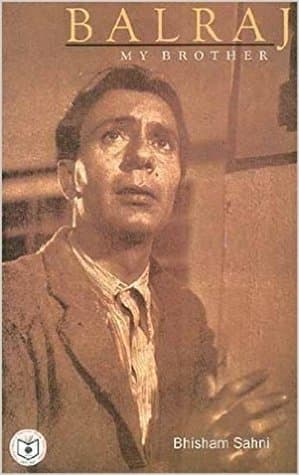
Balraj, My Brother by Bhisham Sahni
The celebrated English author and thinker, C.S. Lewis, once noted, "Friendship is unnecessary, like philosophy, like art.... It has no survival value; rather it is one of those things which give value to survival." While I am disinclined to discuss my personal friendships on a public platform, I fully attest to his views on philosophy and art. For me, books, films, and music have never been mere pastimes; they have been the very scaffolding of my inner life. Yet, in traditional Indian middle-class families—where the overriding concerns are securing a decent livelihood and building enough wealth to weather future storms—such abiding interests are often dismissed as the eccentricities of a superficial mind, particularly when these pursuits yield no material return.
When it comes to Hindi cinema, the figures who have influenced me most are Balraj Sahni, Nutan, and Sanjeev Kumar. I admire them not only for their impeccable, exceptional artistry but also for the profound humanity they projected off-screen. A defining trait—or rather, a monumental accomplishment—shared by these three artists is their ability to entirely dissolve into the characters they portray, completely effacing their own personas. This remains a rare feat in Hindi cinema, an industry that has historically relied on the manufactured star power of its performers rather than genuine, subtle Characterisation. Yet, even among these three masters, Balraj Sahni captivates me the most, transcending the boundaries of cinema into all spheres of life. Whenever I think of him, four vivid images involuntarily play in my mind like slides in a bioscope: the impoverished peasant rickshaw puller of Do Bigha Zamin, the displaced Pathan of Kabuliwala, the compassionate social reformer of Seema, and the dignified, elderly Muslim gentleman of Garam Hawa. What is remarkable is that while he completely surrenders himself to these disparate roles, his innate purity, kindness, and gentleness seamlessly transcend the characters to deeply touch the viewer. It is this rare quality that reveals the man behind the actor.
It was with palpable anticipation, eager to learn more about this legendary figure, that I began reading his biography at the start of this month (August 2026). Penned by his younger brother, Bhisham Sahni—a celebrated Hindi literary giant in his own right—Balraj, My Brother was first published by the National Book Trust in 1981. It is a deeply touching memoir. Rather than a detached chronicle, I found it to be an honest, profoundly affectionate, and insightful portrait that beautifully tracks Balraj’s expansive life journey. The narrative sweeps from his comfortable, middle-class upbringing in Rawalpindi and his vibrant student days in Lahore, to his time at Shantiniketan in the company of Gurudev Tagore, his days at Sewagram alongside Mahatma Gandhi, and his four years in London with the BBC. From there, it dives into his tumultuous entry into Bombay cinema, marked by intense professional and personal struggles, before finally settling into his profoundly poignant and reflective final years.
Written in simple, highly accessible English with a mildly self-deprecating tone, the author’s absolute adulation for his elder brother shines through each of its 154 pages. Balraj Sahni remained an unwavering idol for Bhisham from their shared childhood right until 1973, when Balraj breathed his last. Reading his life story, it is impossible not to stand in awe of such a personality. He was an exceptional artist, a committed idealist, and a humanist whose profound humility never allowed him to take himself too seriously. Yet, that very humility propelled him to work tirelessly for the causes closest to his heart: literature, drama, cinema, social justice, and the passionate promotion of his mother tongue, Punjabi.
While the author’s devotion to his elder brother is unmistakable, what struck me most is his ability to write without slipping into excessive sentimentality. Bhisham Sahni masterfully presents his brother as both a monumental artistic icon and a warm, grounded, socially conscious human being. Being a biography, the book naturally keeps its lens fixed on its subject, but it also brilliantly captures the sweeping sociopolitical upheavals of twentieth-century India—from the trauma of the Partition to the fiery evolution of the Indian People's Theatre Association (IPTA) and the vibrant cultural currents of the era. The narrative gains an incredible intimacy through a rich repository of shared conversations and excerpts from the letters Balraj regularly sent to his brother. Through these private dialogues and candid correspondences, Balraj Sahni emerges as a deeply sensitive man of integrity and uncommon intellectual depth—someone who, despite his public stature, quietly endured his own heavy share of internal conflicts, self-doubts, and moments of desolation caused by personal tragedies.
Balraj Sahni’s life story unfolds like an immersive, deeply engaging novel, shaped by distinct, transformative milestones that systematically forged a privileged youth into aconscientious artist. While it would not be an expedient or productive exercise for this review to recount every single stage of his life in exhaustive detail, the absolute essence of the milestones that defined him must be shared.
Balraj was born in Rawalpindi in 1913, entering the world as the fourth child and first son of a traditional, orthodox Punjabi family who were staunch adherents of the Arya Samaj. Originally named Yudhishthir Sahni, his upbringing was remarkably comfortable; his father ran a successful import business, and the wealth allowed them to own a summer house in Srinagar, where they spent blissful months every year. This early connection seeded a lifelong affinity for Kashmir within Balraj. He returned to the valley frequently throughout his life and even collaborated on a film dedicated to the region, centering the story on a local Kashmiri poet.
While studying at Government College, Lahore, his artistic sensibilities began to stir as he developed an abiding passion for dramatics and literature. Yet, after earning his master’s degree in English literature, he temporarily paused his creative dreams. Yielding to his father's persistent insistence, he briefly joined the family import business, but quickly found the rigid commercial routine underwhelming, suffocating, and entirely at odds with his restless spirit.
Balraj was simply not built to toe societal lines or conform to conservative expectations. This independent streak was fully on display following his marriage to Damyanti—the younger sister of a close friend who had also been his English teacher in Rawalpindi. Delightfully unbothered by the rigid social codes of the era, the newlyweds openly reveled in their conjugal bliss; Balraj would casually seat Damyanti on his bicycle, riding around the town to explore the city together. Though such public affection and free-spiritedness were heavily frowned upon in the orthodox society of those days, it mattered little to him.
Seeking a fresh start on their own terms, the young couple broke away from the family business and relocated first to Lahore, where Balraj launched a weekly English newspaper, “Monday Morning” - a brave venture that failed miserably due to his absolute inexperience. Undeterred, they moved to Kolkata, where he tried to carve out a space for himself by contributing articles to various newspapers and magazines. The income was meagre, and the couple constantly found themselves struggling to make ends meet.
It was from these financial hardships that they transitioned to Visva-Bharati University, where Balraj took up a position teaching Hindi. Both Balraj and Damyanti instantly fell in love with the idyllic and peaceful ambience of Shantiniketan, deeply soaking in the quiet yet intellectually stimulating environment. This place left an indelible mark on Balraj’s soul- so much so that in his later years, he harboured a deep dream of creating a Shantiniketan-style school in the valleys of Kashmir. It was here, amidst this quiet brilliance, that he forged a bond with Hazari Prasad Dwivedi and walked in the towering presence of Rabindranath Tagore. In a beautiful twist of fate, it was Tagore who advised this English-literature graduate to write in his native tongue, planting the seed for his future renown as a Punjabi writer.
Yet, his restless quest for a higher purpose soon drew him further. In 1938, he and Damyanti moved to Sevagram. Rather than living within the main Wardha Ashram, they stayed in a house just outside it, embracing a life beautifully shorn of material possessions. Immersing himself in the publication division of Gandhiji's inner circle, these two years fundamentally reshaped him. It was here that he discovered the true joy of a minimalist existence, while infusing his worldview with a fierce nationalist idealism that he would carry for the rest of his life.
But his global journey was just beginning. As World War II broke out, he moved across the oceans to England, stepping into the role of a radio announcer for the BBC Eastern Service in London. It was this specific, overseas chapter that exposed him deeply to the powerful realism of Soviet cinema, permanently solidifying his lifelong Marxist and socialist convictions.
Upon returning to India from England in 1946, Balraj settled in Bombay, joined the Indian People’s Theatre Association (IPTA), and made his film debut in K.A. Abbas's Dharti Ke Lal. Back home, his father was thoroughly dismayed to learn that both Balraj and his daughter-in-law were working in stage plays. However, during a subsequent visit to Bombay, Balraj convinced his parents to sit through the staging of one of his performances. Witnessing the play’s socially conscious and reformative agenda, his father’s misgivings instantly evaporated; he remarked that – “If this is what you are doing here, I have nothing to complain”.
Yet, those initial years in the tinsel town were brutally difficult, prompting Damyanti to take up acting roles in films just to support the household. Tragic heartbreak struck in 1947 when Damyanti passed away at the tender age of twenty-eight due to a combination of exhaustion and medical negligence, leaving Balraj utterly distraught and consumed by a gnawing sense of guilt. He eventually managed to immerse himself back into work to survive the tragedy. He later married his first cousin, Santosh—a decision that left both sides of the family deeply unhappy and red-faced, as marriages within such close familial ties were strictly taboo.
Interestingly, despite his extensive stage experience, Balraj initially found it incredibly difficult to adapt to the silver screen. He would often freeze, appearing stiff and unable to perform naturally before the camera. Only through persistent, grueling hard work did he manage to conquer this creative block. Throughout these turbulent phases, his enduring bonds with legendary figures like filmmaker Chetan Anand - a camaraderie that stood the test of time from their youthful days in Rawalpindi all the way to Bombay - alongside his abiding friendships with K.A. Abbas and M.S. Sathyu, firmly establish the profound value he always placed on loyalty and friendship.
His iconic portrayal of the desperate rickshaw puller, Shambu, in Bimal Roy's neo-realist masterpiece Do Bigha Zamin (1953) permanently cemented his legacy. To prepare for the character, he famously spent days running barefoot through the scorching streets of Kolkata, learning the physical and emotional vocabulary of actual rickshaw pullers. While the worldwide success of this film brought him immense stardom and led to many more brilliant roles, Balraj remained deeply dissatisfied with the naked commercial dictates of Bollywood. He frequently lamented the superficiality of the films being produced. Yet, despite his profound ideological arguments against the industry system, he never harbored an ounce of malice toward individuals, always speaking warmly and effusively of his colleagues. He intentionally continued working in commercial cinema to earn enough funds to realize his ultimate dream: establishing a Shantiniketan-style school in Kashmir. Even at his busiest, he made frequent, passionate visits to Punjab to collaborate with local writers for the growth of Punjabi literature, just as he routinely traveled to Kashmir to contribute meaningfully to its cultural landscape.
The biography beautifully yet painfully addresses these heavy emotional milestones. Years after the premature loss of Damyanti, Balraj was hit by an even more shattering blow—the sudden, tragic death of his young daughter, Shabnam, in 1972, which left him completely broken. His private letters to Bhisham Sahni during these final months lay bare a profound sense of desolation and bone-deep loneliness. That such an intrinsically creative, optimistic, and compassionate human being was forced to endure such heavy sorrow raises deep, philosophical questions about the meaning of our existence. It brought to mind a deeply felt, personal reflection shared with me recently by a very dear friend, who noted that 'in the end, what remains are the regrets and the distance.'
Balraj Sahni’s final cinematic milestone was M.S. Sathyu’s Garam Hawa, a masterpiece dealing with the raw trauma of Partition. In it, he enacted the role of Salim Mirza, an elderly, respectable Muslim shoe manufacturer in Agra who helplessly watches his family, business, and world fracture and fall apart. In a poignant twist of fate, Balraj completed the dubbing for this film just a day before he suffered a fatal heart attack on April 13, 1973. Alongside Do Bigha Zamin, this stands as his masterpiece, universally acclaimed for its brilliantly understated, subtle performance. Tragically, he did not live to witness its monumental success.
Through this brilliant and deeply moving biography, Balraj Sahni ultimately emerges as a profoundly sensitive and intellectually alive man. He was someone guided entirely by the pure pursuit of art and literature, remaining famously indifferent to material wealth, political power, or social position — a detachment underscored by his quiet refusal of a nomination to the Rajya Sabha. Instead, he remained steadfast in his love, commitment, and loyalty toward his family and friends. His life stands as a luminous testimony to these ideals. Yet, what makes this portrait truly complete is that his regrets reveal just as much about the nobility of his character as his greatest accomplishments do. His lingering sorrow over being unable to save his first wife, his remorse at not spending more time with his children during their formative years, his disappointment at not seeing his beloved Punjabi language gain its rightful status, his unfulfilled dream of establishing a Shantiniketan in Kashmir, and the poignant pain of being unable to resolve the emotional crises of his beloved daughter Shabnam, which might have saved her life — all speak of a man who measured his life not by commercial success, but by the depth of his convictions and the scale of his humanity.
Thank you, Balraj Sahni, for the kind of life you lived; and thank you, Bhisham Sahni, for allowing me to know the man behind the actor.
Excerpts
Excerpt - 1 (Page 46)
"The craving to live in a bigger world, to expand his horizons and enlarge his sphere of experience, to know more about people and places, was something intrinsic to his nature... It was the inner urge to grow, to live a fuller life, to seek self-expression in a wider sphere that made him restless and forced him to make new experiments."
Excerpt - 2 (Page 94)
"She would come home, tired from the studio and I would want her to get busy with household work. To assert my superiority as a man, I would take upon myself even unnecessary jobs of the IPTA... It hurts me deeply to remember these things. Dammo was a precious jewel, bestowed upon an undeserving person, who did not know its value and did not feel grateful for it."
Excerpt – 3 (Page 98)
On the eve of Diwali... [Balraj] overheard a brief conversation between his two children. Parikshit was saying to his sister, Shabnam, 'What a silly things crackers are! People waste money for nothing.' The children had sensed the situation in the house. The piece of conversation overheard, touched Balraj to the quick so much that he retraced his steps, borrowed some money from a friend and brought crackers and sweets for his children."
Excerpt - 4 (Page 100)
A voice rose within me. To hell with the art of acting!.....Who is a more fortunate person than myself who has had the privilege of telling the world the story of a suffering, helpless man... Then I, as it were, imbibed the soul of this middle-aged rickshaw-puller within me, and stopped thinking about the art of acting. I think the real secret of the unexpected success of my role lay in this."
Excerpt – 5 (Page 151)
Money was never a consideration with him... 'I am that proverbial monkey who shuns the fire, and yet, must put his hand into it,' he wrote about himself once. His zest for life was infectious... Even in his darkest moments, he would think of life as something very precious, of which every moment should be lived fully and joyfully.