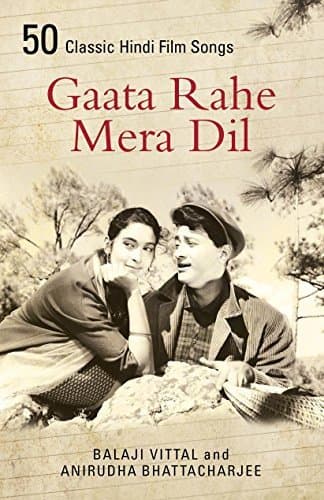
Gaata Rahe Mera Dil: 50 Classic Hindi Film Songs by Anirudha Bhattacharjee and Balaji Vittal
Authors: Anirudha Bhattacharjee and Balaji Vittal
Publisher: HarperCollins Publishers India, 300 pages
Listening to the classic Hindi songs of the golden era (1950–1970) never fails to lift my mood. It is one of those intentional engagements that provide unmitigated joy and a sense of peace, irrespective of whether the song itself is exuberant, romantic, poignant, philosophical, existential, or sad.
When I first came across a review of this book in The Indian Express after its publication in 2015, I was intrigued. How could anyone pick just 50 songs out of a repository of over a hundred thousand gems and term them "classics"? But my initial shock soon gave way to curiosity. I promptly got a copy and read through a few chapters. For some inexplicable reason, I didn’t finish the book back then, and it got lost in a corner of my bookshelf, almost forgotten.
A few months ago, I had a couple of long discussions about classic tracks with a dear friend—a music aficionado and a thoroughly unapologetic, hopeless romantic when it comes to Hindi film music. Our deeply engaging conversations made me crave a closer look at the backstories of these timeless melodies, which suddenly jogged my memory. I remembered owning this book. The forgotten tome was frantically searched for, found, and restarted with great enthusiasm. Since the beginning of July this year, I have read one chapter every day, listened to the featured song on YouTube, and made my own summary, often going well beyond the content of the book.
The book opens with a brief note on the dawn of playback singing in Hindi cinema, followed by a song for the prologue. Their selection for the prologue is brilliant; there couldn’t be a better choice than the timelessly brilliant "Baabul Mora" by K.L. Saigal, a gem from the 1930s. The song was a sensation that touched countless hearts and bowled the nation over with its music, lyrics, rendition, and history—the story of the exiled Nawab Wajid Ali Shah, ousted from Awadh and sent away to Calcutta.
After this brilliant prologue, the book moves on to its main focus: fifty landmark songs chosen by the authors to define their version of a "classic." They cast a wide net across more than five decades, spanning the years from 1941 (Chale Pawan Ki Chaal from Doctor) to 1992 (Dil Hai Chhota Sa from Roja). The book ends with a landmark non-film song (Ae Mere Watan Ke Logon) and a more contemporary track (Ae Ajnabi from Dil Se.
Each song gets its own chapter, prefaced by a screenshot from the movie along with basic details: film, song title, year of release, lyricist, composer, and singer.
The four to six pages devoted to each track provide details like the musical composition, raga base, instrumentation, the meaning of the lyrics, insights into what makes it special, creation anecdotes, its enduring legacy, and trivia.
Admittedly, this structural treatment is not entirely consistent across the book. The blueprint changes from chapter to chapter; some tracks receive a deep, technical breakdown of their musical structure—exploring mukhda, antra, sur, taal, and octaves—while others skip these elements entirely to give lopsided space to biographical backstories or lengthy interview transcripts. Thankfully, the authors have wisely limited the highly technical jargon to just a paragraph or two, keeping the overall book accessible to the lay reader.
But don't let the uneven formatting fool you; the book remains an absolute treasure trove of information. The heavy slant toward anecdotes and trivia actually works in the book's favor, keeping the reader thoroughly engaged. Some of these historical nuggets are indeed worth cherishing. For instance, did you know that Kishore Kumar chose "Woh Shaam Kuch Ajeeb Thi" (Khamoshi) as his personal favourite? Or that M.S. Subbulakshmi was originally slated to sing Hum Dono’s "Allah Tero Naam"? Or that Upkar could have been Rajesh Khanna’s first negative role if he hadn't refused Manoj Kumar’s initial offer to play Puran? You also read about how music director Chitragupta first met Mohammed Rafi when they were both just chorus singers. My favorite anecdote details how Ahmed Jan Thirakwa, the legendary tabla maestro, was so bowled over by S.D. Burman's rendition of "Sun Mere Bandhu Re" from Sujata that he insisted on meeting the singer immediately. It is also wonderful to read how Rabindrasangeet has been re-engineered into so many Hindi film songs, from "Mera Sundar Sapna Beet Gaya" (Do Bhai) to "Tere Mere Milan Ki Yeh Raina" (Abhimaan) and "Pyar Hua Chupke Se" (1942: A Love Story).
There is no way any Hindi film aficionado will agree one hundred per cent with the authors' playlist, which is perfectly reasonable. They state clearly that the tracks are simply their "personal favourites." I respect their selection criteria, and I must add that for most of the choices (around 30 to 35 out of 50), I have no quibble whatsoever.
Irrespective of personal preferences, the representation is quite balanced, covering every mood and inclination. There are several romantic numbers—as any curated list of Hindi film songs must have—but it is gratifying to discover that the list is dominated by profound tracks that are philosophical, existential, spiritual, or melancholy. Some of these are my all-time favourites, and it was a true pleasure to revisit them. In particular, I loved seeing tracks like "Sun Mere Bandhu Re" (Sujata), "Man Tadpat Hari Darshan Ko Aaj" (Baiju Bawra), "Allah Tero Naam" (Hum Dono), "Man Re Tu Kahe Na Dheer Dhare" (Chitralekha), "Ae Mere Pyare Watan" (Kabuliwala), "Kasme Waade Pyar Wafa" (Upkar), "Zindagi Ka Safar Hai Yeh Kaisa Safar" (Andaz), "Zindagi Kaisi Hai Paheli" (Anand), "Jaane Kahan Gaye Woh Din" (Mera Naam Joker), "Ek Pyar Ka Nagma Hai" (Shor), "Kai Baar Yun Bhi Dekha Hai" (Rajnigandha), and "Dil Dhoondhta Hai Phir Wahi" (Mausam).
I must also mention that the inclusion of "Jaag Dil-E-Deewana" from Oonche Log and "Chain Se Humko Kabhi" from Pran Jaye Par Vachan Na Jaye surprised me in the most pleasant way. These exceptional numbers are rarely discussed or recalled by the average listener.
If I were asked to make my own list of 50 personal favourites, I would certainly swap out some of the featured songs for my own missing favourites. My list would include:
The Grand Classics: "O Duniya Ke Rakhwale" (Baiju Bawra), "Pyar Kiya To Darna Kya" (Mughal-e-Azam), and "Jaane Kya Tune Kahi" (Pyaasa).
Romantic Essentials: "Aap Ki Nazron Ne Samjha" (Anpadh), "Tera Mera Pyar Amar" (Asli-Naqli), "Naino Mein Badra Chhaye" (Mera Saaya), "Tere Mere Sapne Ab Ek Rang Hain" and "Din Dhal Jaaye Raat Na Aaye" (both from Guide), "Kuch Dil Ne Kaha" (Anupama), "Aaja Piya Tohe Pyar Doon" (Baharon Ke Sapne), and "Yeh Dil Aur Unki Nigaahon Ke Saaye" (from the unreleased Prem Parbat).
The Melancholic Masterpieces: "Main To Tum Sang Nain Milake" (Manmauji), "Humne Dekhi Hai Un Aankhon Ki Mehakti Khushboo" (Khamoshi), "Zindagi Ke Safar Mein Guzar Jaate Hain" (Aap Ki Kasam), "Dil Cheez Kya Hai" and "Yeh Kya Jagah Hai Doston" (both from Umrao Jaan).
The Philosophical and Spiritual Pieces: "Tu Pyar Ka Sagar Hai" (Seema), "Chal Ri Sajni Ab Kya Soche" (Bombai Ka Babu), and "Tora Man Darpan Kahlaye" (Kajal).
My Three Non-Negotiables: "Toote Hue Khwabon Ne" (Madhumati), "Yeh Mera Deewanapan Hai" (Yahudi), and "Kahin Door Jab Din Dhal Jaye" (Anand).
I might agree to rethink a few of them if the list must strictly stick to fifty, but the final three - "Toote Hue Khwabon Ne", "Yeh Mera Deewanapan Hai", and "Kahin Door Jab Din Dhal Jaye" are absolute non-negotiables for me.
Peppered with interesting anecdotes, rich backstories, and trivia, this book offers an incisive analysis of how these chosen songs contributed to the evolution of Hindi film music. Reading it was a thoroughly pleasurable experience. It didn’t matter that many of my own favourites were missing. While its appeal may naturally be stronger for readers who grew up with this kind of music, for souls like me who negotiated their adolescent years with the sole support of All India Radio’s Vivid Bharti Programs and Ceylon Radio’s Binaca Geetmala, it is bound to bring a deep sense of nostalgia and pure joy.