RUN dir. Aneesh C
Saturday evening is our weekly film time. We normally finish before dinner, which is usually around 9:00 to 9:30 PM, meaning we start at about 7:00 PM. However, on the Saturday that just went by (22 August 2026), we couldn't begin at the usual time because of other engagements, and a break in the ritual seemed imminent. Since Manju was very keen on watching a film, the challenge was to find a title with a runtime of no more than 90 minutes.
I was at my wit's end because even relatively short Hindi films rarely come in under 140 minutes. This severely limited our options until I suddenly remembered Run, a recommendation from a dear friend. A quick check on Netflix revealed that its runtime was a perfectly fitting 89 minutes, and the choice was locked in immediately.
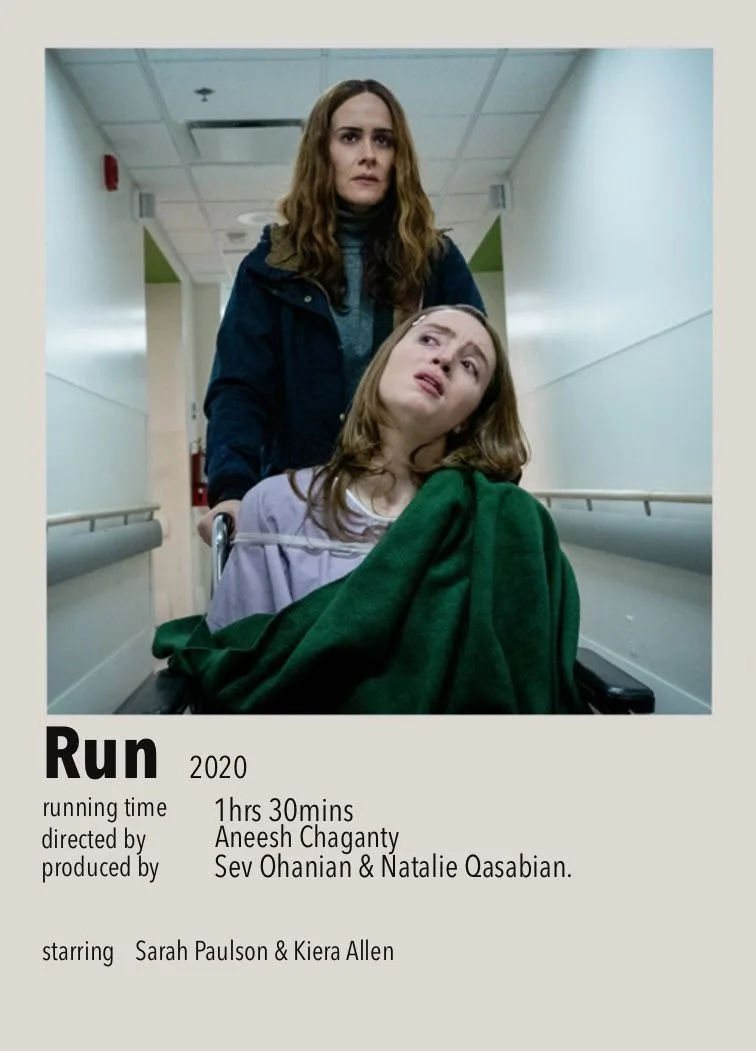
Run is a 2020 American psychological thriller written and directed by Aneesh Chaganty. It stars Sarah Paulson as Diane Sherman and Kiera Allen as Chloe, a disabled, wheelchair-using teenager who uncovers the sinister and controlling secrets of her mother.
A spoiler-free summary of the plot is this: Chloe Sherman is homeschooled in isolation by her devoted mother, Diane. Chloe uses a wheelchair and manages multiple chronic medical conditions. She excels academically and is expecting an admission decision from Washington University. One day, she discovers something that makes her suspicious of her mother. From that point onward, the story follows her desperate attempts to escape, uncover the truth about her past, and break free from her mother's control.
A remarkable aspect of this film is that it features Kiera Allen, a real-life wheelchair user, in the role of the similarly disabled protagonist, Chloe. The directors and producers of Run were deeply committed to authentic casting and conducted a nationwide search to find a talented actress who used a wheelchair. Kiera Allen has used a wheelchair for mobility since 2014, and with her performance as Chloe, she became the first real-life wheelchair user to star in a major American thriller film. Because of her lived experience, the filmmakers invited her to provide input on the script and set design to ensure that the day-to-day realities and mechanics of wheelchair use were portrayed accurately. That attention to authenticity is evident throughout the film. I only learned about Kiera Allen's mobility challenges after watching the film.
Run is the kind of psychological thriller that keeps one glued to the seat, not even allowing a bathroom break or a trip for a glass of water. Every minute of the film, every frame is charged with suspense and a constant sense of foreboding.
I found the rooftop crawl to be the most unforgettable sequence in the entire movie. From a narrative standpoint, it marks the precise moment when the film transforms Chloe from a traditional thriller victim into a full-fledged action hero. As I had found the scene sequence extraordinarily impressive, I got curious to learn more about it. Even on a flat surface, dragging one's entire body weight using only the arms, shoulders, and core requires tremendous upper-body strength. Kiera performed most of the grueling close-up crawling and window-shattering sequences herself, bringing an authentic sense of strain and exhaustion to the character. For some of the wider and more dangerous exterior shots, a professional stunt double was used. Nevertheless, the sequence remains an incredible combination of physical endurance, determined performance, and clever filmmaking.
This is not to suggest that Kiera’s courageous performance is the only outstanding feat of the film. Run is essentially a two-hander and essentially it works because of the tension created between Chloe and Diane. Sarah Paulson, as Diane, Chloe's mother, carries half of the burden in a terrific performance that shifts effortlessly between hysteria and cold calculation. What makes her portrayal so effective is that she never plays the character as a straightforward villain. Her affection, vulnerability, and menace coexist in a deeply unsettling manner.
The film may depict an extreme manifestation of pathological possessiveness, but the questions it raises are universal. How far can love be twisted before it becomes indistinguishable from obsession? And when does the desire to protect someone by keeping them close crosses the line and becomes toxic and dangerous?
Looking back, Run proved to be the perfect choice for a delayed Saturday movie night. In just 89 minutes, it delivered more tension and engagement than many films that run twice as long.