The Station Agent dir. Tom McCarthy
The Station Agent
Watched on 30-August-2026, YouTube
Human beings do not necessarily need grand acts of love or sacrifice. Often, they simply need someone who stays, listens, and accepts them without trying to fix them.
Last Sunday, Manju and I watched this critically acclaimed 90-minute film on the recommendation of our son, Joy. Before watching, I read a little about the film and the reviews it had received, while taking care not to discover too much about the plot. Wikipedia and some other sites describe the film as “American comedy-drama film written and directed by Tom McCarthy in his directorial debut.” But my own impression formed after watching the film and the one that Manju shares with me, is that it is anything but a comedy, no pun intended. It is a quiet, melancholy film about loneliness, grief and human connection. There are moments of humour, but they arise naturally from character and situation rather than from comic contrivance. Calling it a comedy-drama may be technically correct, yet the label barely captures the film's delicate emotional texture.
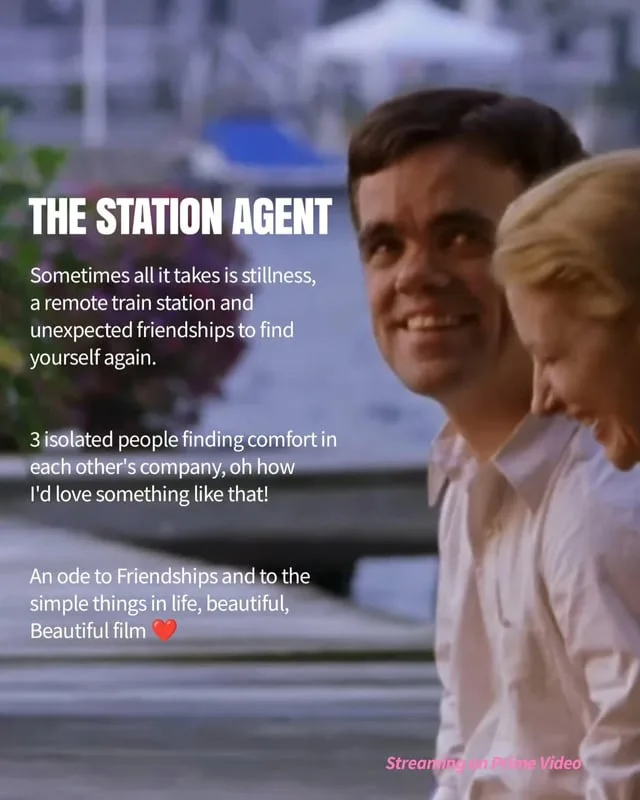
The Plot of the film is deceptively simple, and the story is not complex. Finbar McBride (Fin), a quiet man with dwarfism and a passion for railways, loses his only close friend and unexpectedly inherits an abandoned railway station in rural New Jersey. Retreating there in search of solitude, he instead finds himself drawn into unlikely friendships with Joe, a relentlessly friendly hot-dog vendor, and Olivia, a troubled artist struggling with personal loss.
‘The Station Agent’ is about loneliness, self-protection, grief, companionship, and the slow, almost accidental formation of human connection. Fin's dwarfism is central to his experience, but the film refuses to make it the whole story. It makes one think about the problems people face in their life journey, the demons that they fight, mostly alone, and try to get on as best they can, with some kindness from fellow human beings.
Peter Dinklage is outstanding as Fin. His portrayal of a stoic and fiercely self-contained loner is subtle, restrained and completely convincing. Patricia Clarkson and Bobby Cannavale also deliver nuanced, heartfelt performances as Olivia and Joe.
Many films about marginalized people focus almost entirely on prejudice and the character becomes defined by what others do to them. ‘The Station Agent’ instead of asking: "How does society treat a dwarf?", asks: "Who is this particular person when nobody is looking at him?" Fin is not presented as a representative of dwarfism. He is presented as a railway enthusiast, a reader, a loner, a stubborn man, a friend, and a grieving person who happens to have dwarfism. This kind of restraint is one of the greatest strengths of this sensitive film.
‘The Station Agent’ is humane partly because the world around Fin is gentler than the real world often is. It offers not an exact mirror of society but a vision of how society could be if people behaved a little more like Olivia and Joe. This led me to reflect on why people respond so differently to visible differences. Some react with curiosity, others with ridicule, and a few with genuine empathy.
Curiosity is probably the most common reaction because human beings are naturally attentive to difference. A dwarf, a very tall person, someone with a visible disability, or any unusual physical feature immediately attracts attention. Most people Fin encounters are not consciously cruel. They stare, glance repeatedly, ask insensitive questions, or treat him as an object of fascination.
Ridicule often arises from insecurity rather than confidence. By laughing at someone visibly different, people signal their membership in the majority group. It is a primitive social instinct: "I am one of us, not one of them". The two young men (visitor to Joe’s hot dog joint) who mock Fin are examples of this human tendency. The film wisely does not spend much time on such people because they are not very interesting. Their behaviour is shallow and predictable.
Empathy is among the noblest human capacities. It stands in contrast to ridicule and is distinct from mere curiosity. Curiosity asks: "Why is this person different?" Empathy asks: "What must it be like to be this person?" Most people never make the second leap. The film suggests that empathy is less a matter of virtue than of imagination and life experience. Olivia and Joe are different from others not necessarily because of some innate virtue or because they are morally superior. Rather, both carry wounds of their own. Olivia is living with grief and guilt. Joe struggles with loneliness and an uncertain future. Because they are acquainted with suffering, they are more capable of recognizing suffering in others.
Fin’s fondness for watching trains is quite interesting and central to the story. He genuinely loves trains as manifested in his knowledge about trains, his reading on the subject, and his enthusiasm. But there may be a psychological layer to it. Humans are unpredictable – they disappoint, stare, intrude, leave – by choice or by death. Trains operate according to schedules, routes, and rules. For someone like Fin, who has spent much of his life dealing with difficult social encounters, trains represent a world that makes sense, feels more certain. Trains provide companionship without social demands. For Fin, they are a way of remaining connected to the world while keeping a safe distance from it.
Many films end with major transformations. The Station Agent does something much more modest and therefore more believable. Nobody is cured, nobody's grief disappears and nobody's loneliness vanishes. But when Fin, Olivia and Joe become friends, each becomes slightly less alone. This happens because each offers kindness to the other. This reminded me of one of my favourite quotes by the eminent thinker, philosopher and writer, Aldous Huxley: "It's a little embarrassing that after 45 years of research and study, the best advice I can give people is to be a little kinder to each other." The film almost functions as a cinematic illustration of this profoundly positive idea. Joe's kindness is often clumsy. Olivia's kindness is sometimes hesitant. Fin's kindness is reluctant and disguised beneath irritation. Yet all three gradually make space for one another. The film's deepest insight may be this: Human beings do not necessarily need grand acts of love or sacrifice. Often, they simply need someone who stays, listens, and accepts them without trying to fix them.
What stayed with me after the film was not its treatment of dwarfism, loneliness, grief, or friendship individually, but its faith in small acts of human decency. Fin, Olivia and Joe are all wounded in different ways. None possesses any special wisdom or solutions for the others. Yet by simply showing up for one another, they make life more bearable. In a world that often rewards indifference, The Station Agent reminds us that kindness may be the most underrated human virtue. The film's quiet message seems remarkably close to Aldous Huxley's observation about kindness. This beautiful and sensitive film suggests that kindness may be ordinary, but it is never simple, and perhaps it is exactly what we need most.
Note: Tom McCarthy wrote the role of Finbar McBride specifically for Peter Dinklage, who has achondroplasia and whose own experiences helped shape the character.