Musing 6 - More Than a Menu: Of Sushi, Dahi-Chura and State Banquets
At the recently concluded 18th BRICS Summit in New Delhi, the gala dinner hosted on 12 September 2026 featured an exclusively vegetarian menu. Predictably, the decision triggered criticism from opponents of the ruling party and an equally vigorous defence from its supporters. What strikes me as curious is not merely the decision to serve an exclusively vegetarian menu, but also the suggestion that such a choice, by itself, constitutes an act of dietary imposition or a divisive political statement. Both parties have compelling logic in support of their respective positions. However, the aggressive tone of the discourse and an overweening desire to score political brownie points have ensured a near-total absence of informed discussion. This is an issue that concerns the nation, not just individuals or political outfits. The ensuing cacophony has saddened me, though it has not surprised me. Public discourse today often leaves little room for nuance, with complex issues quickly reduced to ideological binaries.
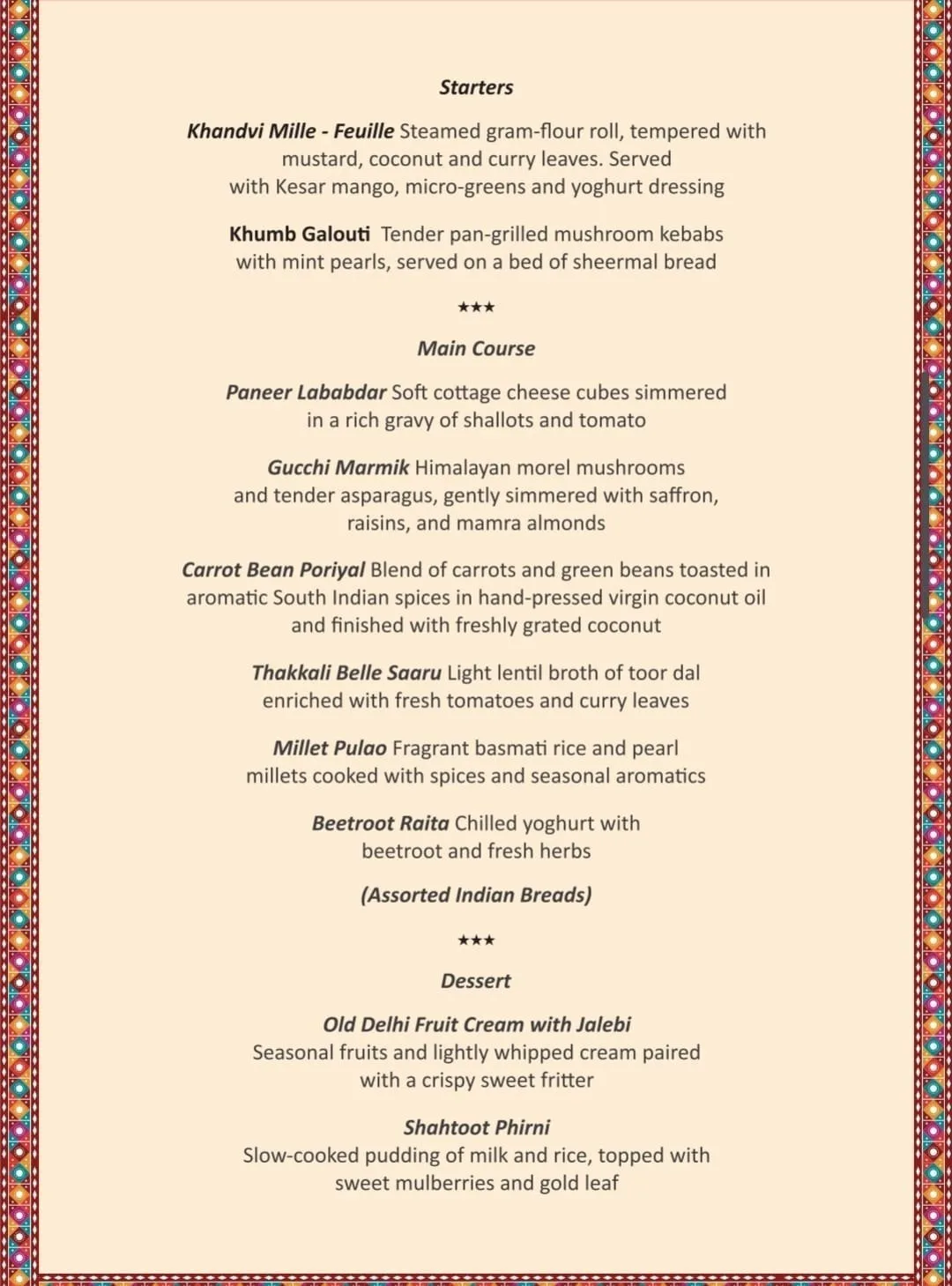
Showcasing the range and sophistication of India's vegetarian culinary traditions
The whole thing reminded me of a family occasion. In June 2021 for the housewarming lunch of our present abode, we had decided on an all-vegetarian menu. The decision was made after some deliberation, and we were apprehensive that the strongest reservation would come from our children, Charu and Joy, both of whom are die-hard unapologetic non-vegetarian. For both, at least two of the day's three meals must contain something beyond plant and dairy products, Tuesdays and Navratri notwithstanding. Apart from periods of illness, Diwali is perhaps the only exception. But we were surprised by their response. They were unequivocal in their opinion that the choice of menu, whether all vegetarian or a combination of two, is entirely the prerogative of the host. It was agreed that the appeal of a dish lies not in whether it is plant-based or meat-based, but in the care, imagination, and skill with which it is prepared.
How differently Gen-Z approaches food was demonstrated by a conversation with our daughter that took place last month. Charu visited us the day before Raksha Bandhan. I asked her whether she had sent Rakhi to Joy at his CALTECH address in Pasadena (California). She replied negatively and, though I was not agitated by the reply, it didn’t please me much. My rational mind tells me that a long and intimate conversation does more to reaffirm sibling affection than any ritual. Yet the emotional side of me, rooted in a sense of civilizational continuity, insists that festivals and symbols matter deeply. I have been steadfast in my belief that these symbols and traditions form the very core of our identity as a people, and if we discard them, we risk becoming little more than an amorphous mass, detached from the traditions that shaped us. Coming back to my conversation with Charu, she said – don’t worry about it, I have talked to Joy, and he indicated that both a Rakhi and a platter of Sushi would cost the same, around 40 Dollars, and the latter would contain as much love as a Rakhi. The way to the heart goes through the stomach.
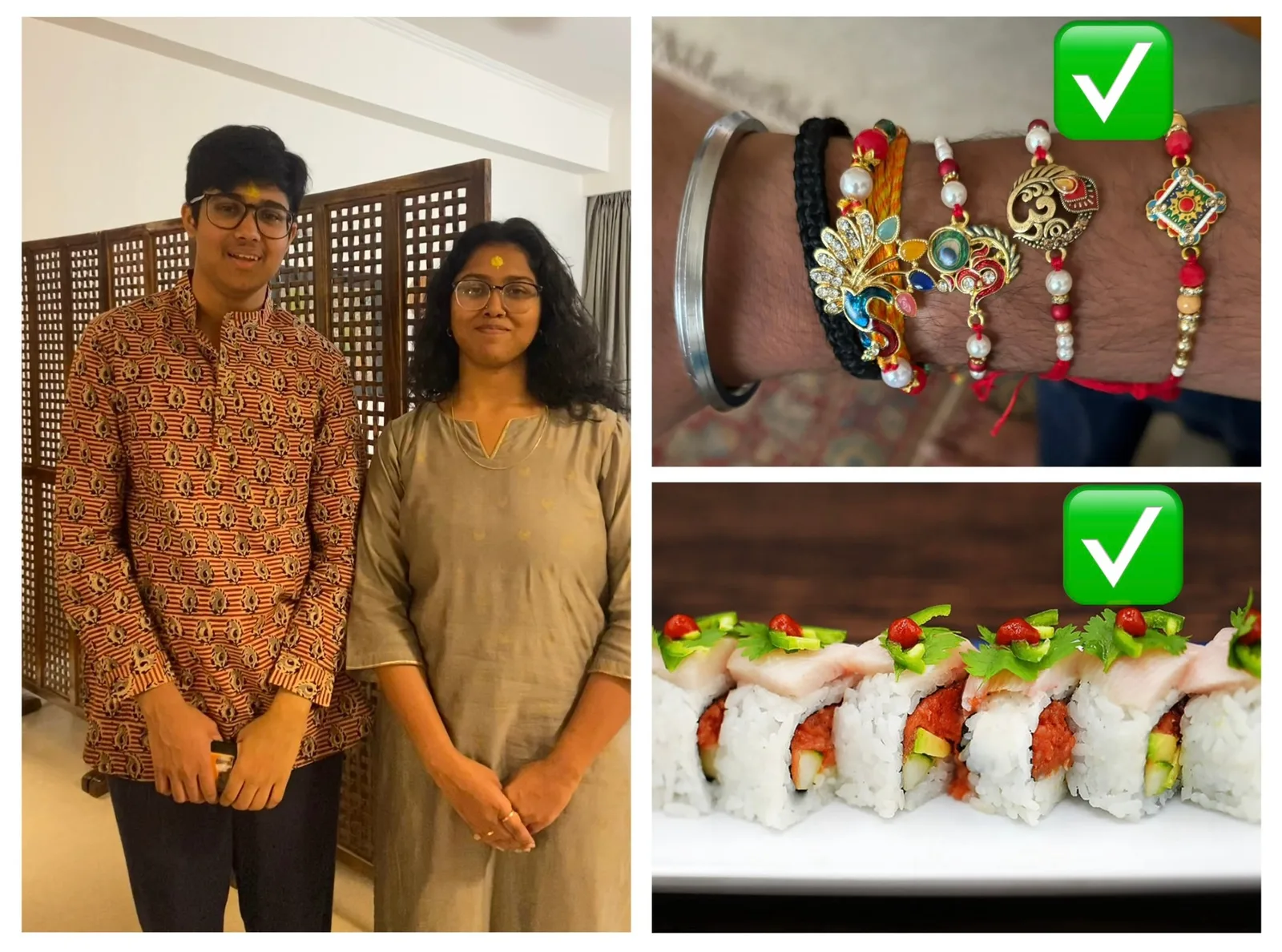
Rakhi and Sushi: two different expressions of the same affection.
Going further back, in the mid-1970s, the country witnessed a major uproar over the use of animal fat in vanaspati ghee, a term commonly used for hydrogenated vegetable-fat products. Old-timers like me will remember brands such as Dalda and Rath. Many Indians were aghast at the revelation, and their indignation was perfectly understandable. After weeks of public outrage, demonstrations, and boycotts, most people eventually resumed using vanaspati ghee despite its high content of unhealthy saturated fatty acids and trans fats. My paternal grandfather, Late Shri Yamuna Pandey (1919-2000), however, was made of sterner stuff. A deeply devout vegetarian, he was so disturbed by the episode that he resolved never again to eat any food prepared with vanaspati ghee. He remained true to that resolve for the rest of his life and this often created a piquant situation for hosts and family members alike. Traditional Hindu community feasts, whether at weddings or funeral gatherings (shraddha), rely heavily on deep-fried foods such as puri and jalebi, and the use of pure ghee on a large scale is usually prohibitively expensive. Yet he never withdrew from social life. He attended such gatherings willingly but simply refrained from eating the food prepared for the occasion. If the hosts went to the trouble of arranging something simple, such as Dahi Chura, a preparation of flattened rice and yogurt, he would graciously partake. Similarly, he had no reservations about sweets made from pure chhena (fresh curdled milk) or khoya/mawa (thickened milk solids). In fact, he occasionally relished white rasgulla and peda despite being prediabetic. Otherwise, a lota of water was often all he consumed. Remarkably, he never expressed resentment or disapproval. I vividly remember him eating Dahi Chura at my wedding in May 1996 at Bettiah (West Champaran, Bihar). He remained steadfast in a choice shaped by his faith yet never assumed moral superiority or sought to impose his convictions on others. That was entirely in keeping with the remarkably unpretentious man he was: unconcerned with elaborate rituals or daily puja, yet unwavering in his determination to align his conduct with his personal beliefs. I have always admired that quiet integrity as opposed to performances and projections.
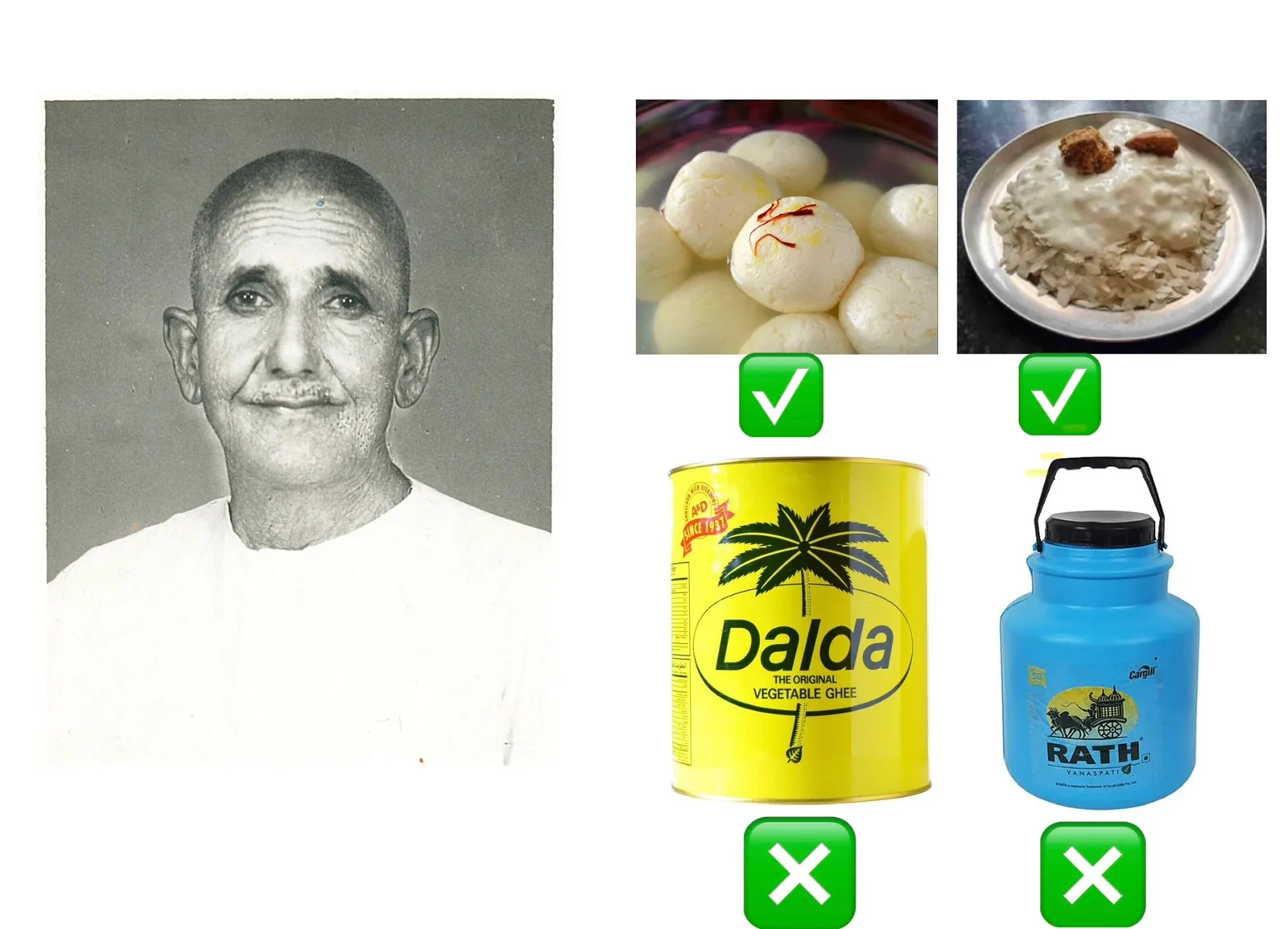
Conviction without imposition: my grandfather's dietary choices.
These incidents, separated by generations and circumstances, remind me that food is rarely just about food. It carries memory, identity, sentiment, and occasionally ideology. Yet at its core, the choice of what to serve remains deeply personal. It is perhaps this intersection of hospitality, culture, and symbolism that makes the debate over a state banquet worth examining. The issue of what a state gala dinner hosted for foreign dignitaries, including heads of states, should be, warrants some deliberation.
The relationship between food and diplomacy is not fundamentally different from the relationship between food and hospitality within a family. A host expresses something about himself through the meal he serves, while a guest reveals something about himself through the grace with which that meal is received. At a state banquet, however, these choices acquire additional symbolic meaning because a nation, rather than an individual, becomes the host. The menu therefore serves a dual purpose: it reflects cultural pride while also conveying respect for the diversity of the guests. Balancing the two is neither simple nor straightforward.
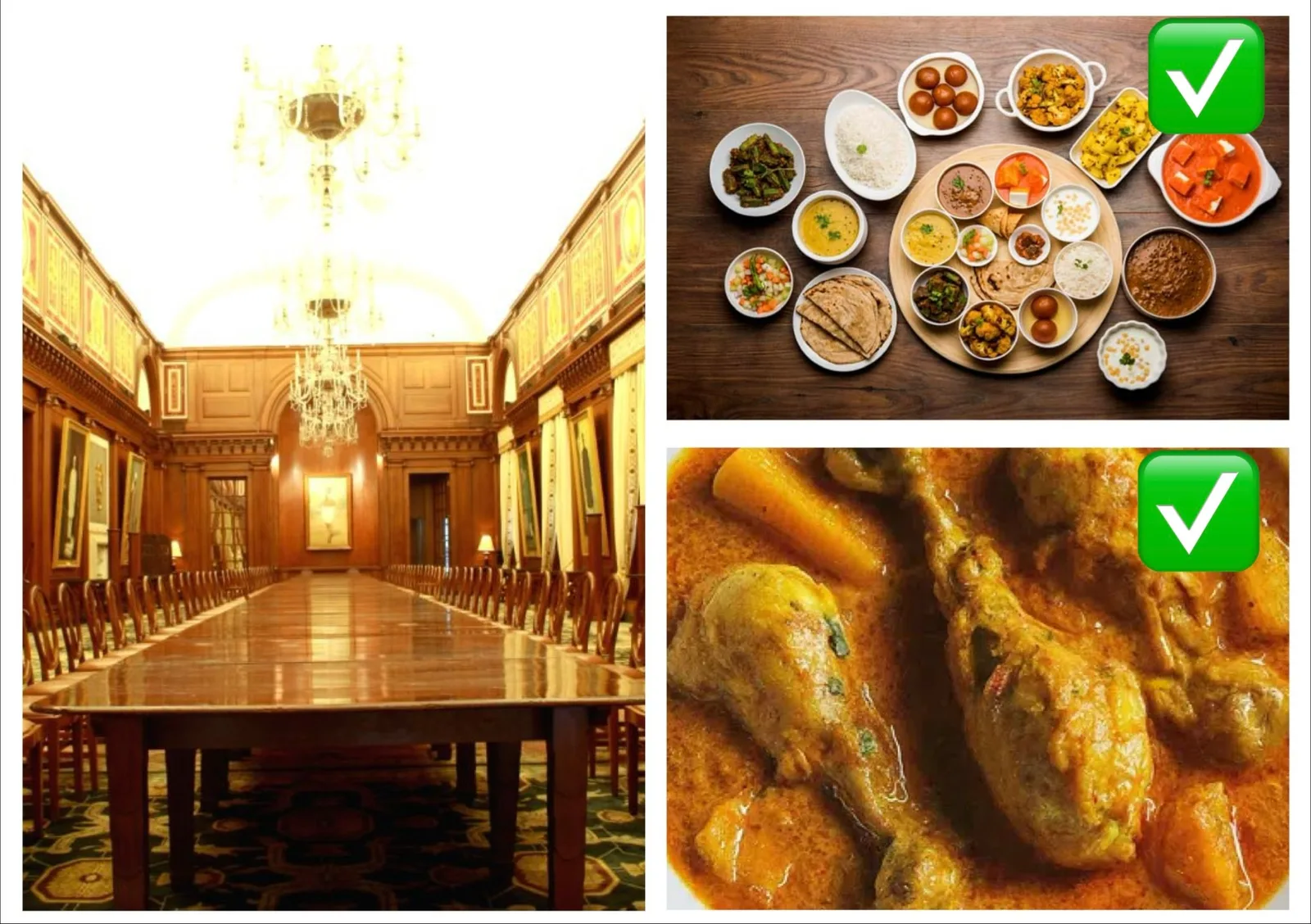
Hospitality is not about choosing sides; it is about welcoming all.
As I reflect on this debate, I am reminded of my children's practical wisdom and my grandfather's quiet conviction. Both, in their own ways, understood that food choices are personal and that courtesy matters more than conformity. My own view remains straightforward. The ideal menu would offer both vegetarian and non-vegetarian options. Yet if a host chooses otherwise, that choice alone should not be seen as an act of imposition. A well-crafted meal can delight whether it comes from a field, a dairy, a river, or a farm. What matters most is the spirit in which it is offered and the generosity with which it is received. In diplomacy, as in family life, good manners often achieve more than loud arguments.
PS: A small disclosure may be in order. Manju and I are vegetarians by choice, guided by personal ethical considerations rather than by any religious prescription. That said, we are perhaps not vegetarians in the strictest sense, as we do consume eggs.