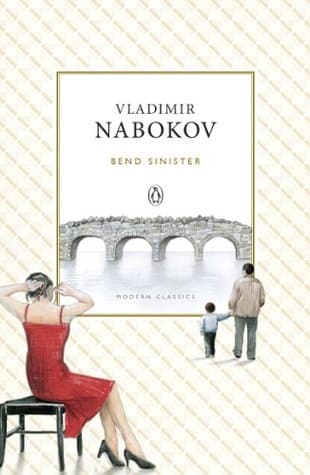
Bend Sinister by Vladimir Nabokov
Bend Sinister, Vladimir Nabokov
Finished reading Bend Sinister, Vladimir Nabokov's 179-page-long novel. I would place it among the most brilliant books I have read; at the same time, however, I found it exceptionally demanding and not easily accessible, owing to its extraordinarily literary tone. By the time I reached the last page, I felt deeply unsettled, almost terrified.
A Father's Day gift from my daughter Charu, it became my third Nabokov novel, the earlier two being Lolita and Pnin. I read Lolita of my own volition many years ago, in my mid-twenties, and feel it is now due for a revisit. Pnin and Bend Sinister, on the other hand, were both read at Charu's prompting, the former having been one of my companions during the Covid-19 years.
Lolita (1955), Nabokov's most famous and controversial novel, is a dazzlingly wrought confession in which Humbert Humbert's verbal brilliance becomes an instrument of self-deception, aesthetic enchantment, obsession, and moral evasion. Pnin (1957), often regarded as Nabokov's warmest and most humane novel, presents a gentle comic portrait of Timofey Pnin, a Russian émigré professor fumbling through the absurdities of American academic life. It is a work of remarkable emotional depth, endowed with Nabokov's signature prose that combines delicacy, humor, and pathos, and offering poignant reflections on exile, memory, lost worlds, survival, cultural dislocation, and the loss of identity.
The earliest of the three, Bend Sinister (1947) is very different from both Lolita and Pnin. Widely regarded as one of the twentieth century's most powerful literary explorations of tyranny, it is Nabokov's darkest political novel, set in a grotesque totalitarian state where ideology seeks to invade and regulate every dimension of private life, ultimately obliterating individuality. It demonstrates how a totalitarian regime seeks not merely obedience, but possession of the human soul. Nabokov’s attack, however, extends beyond political dictatorship. His real target is every ideology that distrusts exceptional individuals and seeks to reduce human beings to interchangeable units. The Party of the Average Man is terrifying precisely because it transforms mediocrity into a moral virtue and treats originality as a form of treason. In Nabokov’s vision, tyranny begins not merely with political power but with the denial of individuality itself. Ethically and philosophically, the novel stands as a passionate defense of personal freedom, imagination, and human uniqueness against the abstractions and fanaticisms of political ideology.
The title of the novel itself puzzled me at first and required some digging to understand. In heraldry (the study of armorial insignia), a bend is a diagonal band across a shield, while a bend sinister is its reversed, left-leaning counterpart. In the preface to the novel, Nabokov describes it as "an outline broken by refraction, a distortion in the mirror of being, a wrong turn taken by life." Later in the same preface, he refers to "a sinistral and sinister world." The title thus comes to symbolize a society in which ordinary human relationships, language, truth, and individuality have been distorted by totalitarian ideology; a reality that has taken a wrong turn and been bent out of shape.
Professor Adam Krug, the country's most renowned philosopher and an original and intellectually honest thinker, is devastated when his beloved wife Olga dies after a failed operation. Left alone with their young son David, he wishes only to grieve in peace. But the new totalitarian regime of Paduk, leader of the Party of the Average Man, sees in Krug an invaluable prize. His international reputation is so great that his public endorsement would lend intellectual legitimacy to a government built on conformity and the suppression of individuality.
Krug's relationship with Paduk goes back to their school days. Paduk, nicknamed "Toad," was an awkward, unpopular boy who admired the gifted and charismatic Krug. Krug never regarded him as an equal, and the childhood imbalance left a lasting wound. Now Paduk, transformed into a dictator, seeks the recognition he could never obtain from his former schoolmate.
Insensitive to the grief Krug is going through, the head of the university sends Dr. Alexander, a suave but diabolical and morally compromised academic, to fetch him to the University for a meeting of those professors who haven’t yet fallen victim to the regime. The Principal asks them to sign a declaration of allegiance, which Krug is expected to deliver personally to Paduk, his former schoolmate. Among those present, only Hedron, a fellow academic and close friend of Krug, has decided against yielding to the regime despite the impending personal risks, though he remains mostly silent at the meeting, speaking only to Krug in a voice of reason. But unlike Krug, he is acutely aware of the implications. Krug flatly refuses the offer and returns to his home. When persuasion fails, the regime turns to intimidation. The following morning, Hedron visits Krug at his apartment. The two friends discuss the worsening situation, but as Hedron leaves, he is arrested by the authorities. Soon, friends and colleagues are rounded up and sent to prisons where torture is routine. Among them are Professor Ember (Krug's closest friend and a distinguished Shakespeare scholar), elderly Mr & Mrs. Maximov (neighbors and well-wishers of Krug from his native place); and Hedron himself.
Yet Krug refuses to endorse the regime's philosophy of enforced equality as he doesn’t foresee any immediate danger to himself or his son, convinced that the regime values his reputation too highly to risk harming him. Paduk then resorts to a crueler tactic. David is kidnapped, and Krug is led to believe that cooperation will secure his son's release. For the first time, his resistance breaks. But the concession is useless. Through a grotesque bureaucratic blunder, David has already been sent to a prison-like institution and killed. The boy's death is not even politically motivated; it is the senseless consequence of a system that has ceased to value human lives. Olga's death had wounded Krug; David's death destroys him. His mind collapses under a burden of grief that reason cannot bear. In the novel's surreal final pages, he descends into madness, while the boundaries between reality and fiction seem to dissolve. In a metaphysical ending, the soldiers then shoot him, completing the destruction of a man who has lost his wife, his friends, his son, his sanity, and finally his life.
Another thing that terrified me in the novel is the way Dr. Alexander has been drawn. He is an academic: educated, intelligent, polished in manner, and outwardly civilized. Yet, for the sake of self-preservation, he has become a willing instrument of a dystopian regime and reached a stage where human suffering has become subordinate to wit, irony, and social poise. What makes him particularly terrifying is the contrast with Hustav, perhaps the most openly abhorrent character in the novel, the official who comes to arrest Krug's friend Ember. Hustav is selfish, insensitive, unscrupulous, and vulgar. But, like Paduk, he is easy to judge. Alexander is harder to comprehend because he is intelligent and civilized yet detached from humanity. He has acquired the ability to stand beside horror without being emotionally engaged by it. The idea that a person can remain charming, articulate, and cultivated while becoming morally anaesthetized within such a system is, to me, one of the novel's most disturbing insights. One further aspect of the novel that struck me was the fate of those who choose to serve the regime. Time and again, Nabokov shows that accommodation offers no real security. The state eventually turns on many of its own instruments, often with the same cruelty and arbitrariness that it directs against its opponents. It is as if the novel is reminding us that, in a truly totalitarian order, nobody is ever safe; immunity is only an illusion, and victimhood often becomes a matter of time and circumstance.
As I mentioned in the beginning, it is an immersive read but not an easy one. It demands sustained concentration and indeed I found it difficult to read more than 15-20 pages in one sitting. A reader benefits greatly from familiarity with Shakespeare, Greek mythology, and the Roman Empire for a fuller appreciation of the novel. Chapter 7 of the book is deep intellectual conversation between Krug and his friend Ember. Using Macbeth as the template, it is a sharp satire on all totalitarian regimes and one needs to know Macbeth by heart to understand each of the satires. Further, some of the important lines are in French or German and that makes it harder. Because of this, after reading the first few chapters in Penguin Modern Classics paperback, I switched to its Kindle edition, where locating the required references became much easier. Although stylistically very different from Ernest Hemingway, Nabokov shares Hemingway’s economy: he never wastes words. He believed that great art resides in precision, suggestion, and imagination, not in overwhelming the audience with excessive description. Whenever I read a book, I underline the remarkable passages with pencil and soon I realised that if I follow this practice in case of Bend Sinister then hardly a paragraph would be left without being underlined.
A passage that touched me emotionally is Krug’s sentiments about his son David, whom he loved beyond words:
Chapter 13 (page 136-137):
“And what agony, thought Krug the thinker, to love so madly a little creature, formed in some mysterious fashion (even more mysterious to us than it had been to the very first thinkers in their pale olive groves) by the fusion of two mysteries, or rather two sets of a trillion of mysteries each; formed by a fusion matter of pure enchantment; thus formed and then permitted to accumulate trillions of its own mysteries; the whole suffused with consciousness, which is the only real thing in the world and the greatest mystery of all. He saw David a year or two older, sitting on a vividly labelled trunk at the customs house on the pier. He saw him riding a bicycle in between brilliant forsythia shrubs and thin naked birch trees down a path with a ‘no bicycles’ sign. He saw him on the edge of a swimming pool, lying on his stomach, in wet black shorts, one shoulder blade sharply raised, one hand stretched shaking out iridescent water that clogged a toy destroyer. He saw him in one of those fabulous corner stores that have face creams on one side and ice creams on the other, perched there at the bar and craning towards the syrup pumps. He saw him throwing a ball with a special flip of the wrist, unknown in the old country. He saw him as a youth crossing a technicoloured campus. He saw him wearing the curious garb (jockeylike except for the shoes and stockings) used by players in the American ball game. He saw him learning to fly. He saw him, aged two, sitting on his chamber pot, jerking, crooning, moving by jerks on his scraping chamber pot right across the nursery floor. He saw him as a man of forty.”
Bend Sinister to me is not merely a political novel, but a tragic account of how a totalitarian world crushes individuality, love, and human dignity. Few novels I have read portray with such relentlessness the crushing of an individual by a totalitarian state. What makes the tragedy particularly devastating is that Krug is destroyed not only politically, but also as a husband, a father, a friend, and ultimately as a human being.
Finished reading Bend Sinister, Vladimir Nabokov's 179-page-long novel. I would place it among the most brilliant books I have read; at the same time, however, I found it exceptionally demanding and not easily accessible, owing to its extraordinarily literary tone. By the time I reached the last page, I felt deeply unsettled, almost terrified.
A Father's Day gift from my daughter Charu, it became my third Nabokov novel, the earlier two being Lolita and Pnin. I read Lolita of my own volition many years ago, in my mid-twenties, and feel it is now due for a revisit. Pnin and Bend Sinister, on the other hand, were both read at Charu's prompting, the former having been one of my companions during the Covid-19 years.
Lolita (1955), Nabokov's most famous and controversial novel, is a dazzlingly wrought confession in which Humbert Humbert's verbal brilliance becomes an instrument of self-deception, aesthetic enchantment, obsession, and moral evasion. Pnin (1957), often regarded as Nabokov's warmest and most humane novel, presents a gentle comic portrait of Timofey Pnin, a Russian émigré professor fumbling through the absurdities of American academic life. It is a work of remarkable emotional depth, endowed with Nabokov's signature prose that combines delicacy, humor, and pathos, and offering poignant reflections on exile, memory, lost worlds, survival, cultural dislocation, and the loss of identity.
The earliest of the three, Bend Sinister (1947) is very different from both Lolita and Pnin. Widely regarded as one of the twentieth century's most powerful literary explorations of tyranny, it is Nabokov's darkest political novel, set in a grotesque totalitarian state where ideology seeks to invade and regulate every dimension of private life, ultimately obliterating individuality. It demonstrates how a totalitarian regime seeks not merely obedience, but possession of the human soul. Nabokov’s attack, however, extends beyond political dictatorship. His real target is every ideology that distrusts exceptional individuals and seeks to reduce human beings to interchangeable units. The Party of the Average Man is terrifying precisely because it transforms mediocrity into a moral virtue and treats originality as a form of treason. In Nabokov’s vision, tyranny begins not merely with political power but with the denial of individuality itself. Ethically and philosophically, the novel stands as a passionate defense of personal freedom, imagination, and human uniqueness against the abstractions and fanaticisms of political ideology.
The title of the novel itself puzzled me at first and required some digging to understand. In heraldry (the study of armorial insignia), a bend is a diagonal band across a shield, while a bend sinister is its reversed, left-leaning counterpart. In the preface to the novel, Nabokov describes it as "an outline broken by refraction, a distortion in the mirror of being, a wrong turn taken by life." Later in the same preface, he refers to "a sinistral and sinister world." The title thus comes to symbolize a society in which ordinary human relationships, language, truth, and individuality have been distorted by totalitarian ideology; a reality that has taken a wrong turn and been bent out of shape.
Professor Adam Krug, the country's most renowned philosopher and an original and intellectually honest thinker, is devastated when his beloved wife Olga dies after a failed operation. Left alone with their young son David, he wishes only to grieve in peace. But the new totalitarian regime of Paduk, leader of the Party of the Average Man, sees in Krug an invaluable prize. His international reputation is so great that his public endorsement would lend intellectual legitimacy to a government built on conformity and the suppression of individuality.
Krug's relationship with Paduk goes back to their school days. Paduk, nicknamed "Toad," was an awkward, unpopular boy who admired the gifted and charismatic Krug. Krug never regarded him as an equal, and the childhood imbalance left a lasting wound. Now Paduk, transformed into a dictator, seeks the recognition he could never obtain from his former schoolmate.
Insensitive to the grief Krug is going through, the head of the university sends Dr. Alexander, a suave but diabolical and morally compromised academic, to fetch him to the University for a meeting of those professors who haven’t yet fallen victim to the regime. The Principal asks them to sign a declaration of allegiance, which Krug is expected to deliver personally to Paduk, his former schoolmate. Among those present, only Hedron, a fellow academic and close friend of Krug, has decided against yielding to the regime despite the impending personal risks, though he remains mostly silent at the meeting, speaking only to Krug in a voice of reason. But unlike Krug, he is acutely aware of the implications. Krug flatly refuses the offer and returns to his home. When persuasion fails, the regime turns to intimidation. The following morning, Hedron visits Krug at his apartment. The two friends discuss the worsening situation, but as Hedron leaves, he is arrested by the authorities. Soon, friends and colleagues are rounded up and sent to prisons where torture is routine. Among them are Professor Ember (Krug's closest friend and a distinguished Shakespeare scholar), elderly Mr & Mrs. Maximov (neighbors and well-wishers of Krug from his native place); and Hedron himself.
Yet Krug refuses to endorse the regime's philosophy of enforced equality as he doesn’t foresee any immediate danger to himself or his son, convinced that the regime values his reputation too highly to risk harming him. Paduk then resorts to a crueler tactic. David is kidnapped, and Krug is led to believe that cooperation will secure his son's release. For the first time, his resistance breaks. But the concession is useless. Through a grotesque bureaucratic blunder, David has already been sent to a prison-like institution and killed. The boy's death is not even politically motivated; it is the senseless consequence of a system that has ceased to value human lives. Olga's death had wounded Krug; David's death destroys him. His mind collapses under a burden of grief that reason cannot bear. In the novel's surreal final pages, he descends into madness, while the boundaries between reality and fiction seem to dissolve. In a metaphysical ending, the soldiers then shoot him, completing the destruction of a man who has lost his wife, his friends, his son, his sanity, and finally his life.
Another thing that terrified me in the novel is the way Dr. Alexander has been drawn. He is an academic: educated, intelligent, polished in manner, and outwardly civilized. Yet, for the sake of self-preservation, he has become a willing instrument of a dystopian regime and reached a stage where human suffering has become subordinate to wit, irony, and social poise. What makes him particularly terrifying is the contrast with Hustav, perhaps the most openly abhorrent character in the novel, the official who comes to arrest Krug's friend Ember. Hustav is selfish, insensitive, unscrupulous, and vulgar. But, like Paduk, he is easy to judge. Alexander is harder to comprehend because he is intelligent and civilized yet detached from humanity. He has acquired the ability to stand beside horror without being emotionally engaged by it. The idea that a person can remain charming, articulate, and cultivated while becoming morally anaesthetized within such a system is, to me, one of the novel's most disturbing insights. One further aspect of the novel that struck me was the fate of those who choose to serve the regime. Time and again, Nabokov shows that accommodation offers no real security. The state eventually turns on many of its own instruments, often with the same cruelty and arbitrariness that it directs against its opponents. It is as if the novel is reminding us that, in a truly totalitarian order, nobody is ever safe; immunity is only an illusion, and victimhood often becomes a matter of time and circumstance.
As I mentioned in the beginning, it is an immersive read but not an easy one. It demands sustained concentration and indeed I found it difficult to read more than 15-20 pages in one sitting. A reader benefits greatly from familiarity with Shakespeare, Greek mythology, and the Roman Empire for a fuller appreciation of the novel. Chapter 7 of the book is deep intellectual conversation between Krug and his friend Ember. Using Macbeth as the template, it is a sharp satire on all totalitarian regimes and one needs to know Macbeth by heart to understand each of the satires. Further, some of the important lines are in French or German and that makes it harder. Because of this, after reading the first few chapters in Penguin Modern Classics paperback, I switched to its Kindle edition, where locating the required references became much easier. Although stylistically very different from Ernest Hemingway, Nabokov shares Hemingway’s economy: he never wastes words. He believed that great art resides in precision, suggestion, and imagination, not in overwhelming the audience with excessive description. Whenever I read a book, I underline the remarkable passages with pencil and soon I realised that if I follow this practice in case of Bend Sinister then hardly a paragraph would be left without being underlined.
A passage that touched me emotionally is Krug’s sentiments about his son David, whom he loved beyond words:
Chapter 13 (page 136-137):
“And what agony, thought Krug the thinker, to love so madly a little creature, formed in some mysterious fashion (even more mysterious to us than it had been to the very first thinkers in their pale olive groves) by the fusion of two mysteries, or rather two sets of a trillion of mysteries each; formed by a fusion matter of pure enchantment; thus formed and then permitted to accumulate trillions of its own mysteries; the whole suffused with consciousness, which is the only real thing in the world and the greatest mystery of all. He saw David a year or two older, sitting on a vividly labelled trunk at the customs house on the pier. He saw him riding a bicycle in between brilliant forsythia shrubs and thin naked birch trees down a path with a ‘no bicycles’ sign. He saw him on the edge of a swimming pool, lying on his stomach, in wet black shorts, one shoulder blade sharply raised, one hand stretched shaking out iridescent water that clogged a toy destroyer. He saw him in one of those fabulous corner stores that have face creams on one side and ice creams on the other, perched there at the bar and craning towards the syrup pumps. He saw him throwing a ball with a special flip of the wrist, unknown in the old country. He saw him as a youth crossing a technicoloured campus. He saw him wearing the curious garb (jockeylike except for the shoes and stockings) used by players in the American ball game. He saw him learning to fly. He saw him, aged two, sitting on his chamber pot, jerking, crooning, moving by jerks on his scraping chamber pot right across the nursery floor. He saw him as a man of forty.”
Bend Sinister to me is not merely a political novel, but a tragic account of how a totalitarian world crushes individuality, love, and human dignity. Few novels I have read portray with such relentlessness the crushing of an individual by a totalitarian state. What makes the tragedy particularly devastating is that Krug is destroyed not only politically, but also as a husband, a father, a friend, and ultimately as a human being.