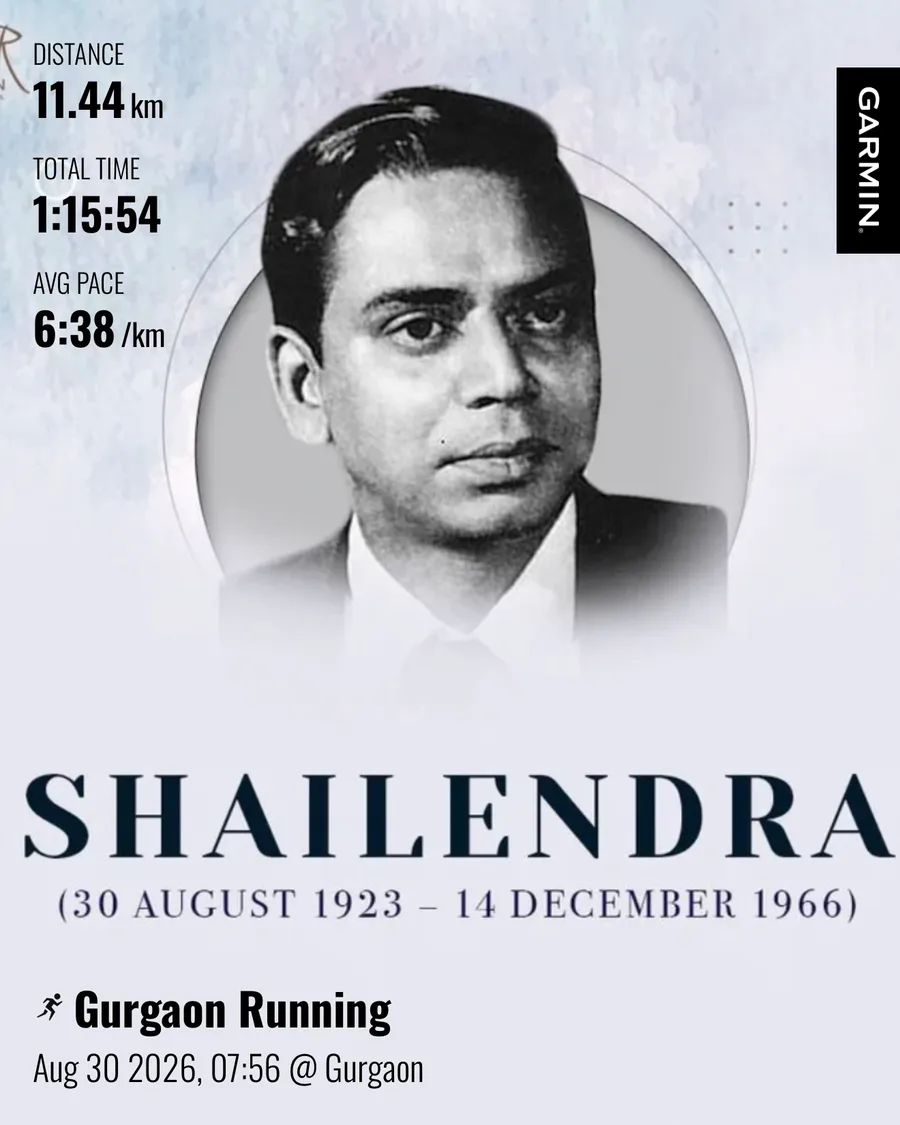
Shailendra: The Poet of the People and Twenty Personal Favourites
Shailendra: The Poet of the People and Twenty Personal Favourites
Shrikant Pandey
30-August-2026, Gurgaon
A morning run in Gurgaon on Shailendra's 103rd birth anniversary, followed by an afternoon in the company of his timeless songs.
Today is the 103rd birth anniversary of Shailendra, one of the absolute greatest poets and lyricists of Hindi cinema’s Golden Era. He possessed a rare genius for turning deeply profound, complex human emotions into simple, conversational Hindi and Urdu words that resonated with both the intellectual and the common man.
Three songs that have remained among my most cherished favourites for decades are
‘Toote Hue Khwabon Ne Humko Yeh Sikhaya Hai’ (Madhumati), ‘Yeh Mera Deewanapan Hai Ya Mohabbat Ka’ (Yahudi), and ‘Tu Pyaar Ka Sagar Hai’ (Seema). Penned by Shailendra, they perfectly showcase his versatility—the first is a haunting heartbreak song, the second a song of obsessive love, and the third, sublime spiritual surrender.
Most of his songs had the haunting, deeply emotional poetic depth that set them apart from the creations of other equally iconic and creative poet lyricists like Sahir Ludhianvi and Majrooh Sultanpuri. Shailendra is called, “the poet of the people” because his lyrics often spoke of the sorrows and struggles of everyday life, yet they also carried a message of hope and resilience. His songs made sublime literature closer to the masses and elevated the cinematic experience to new heights of emotional and intellectual engagement.
I feel a kind of emotional connect, though quite distant and a tenuous one for two reasons. His family originally hailed from the Ara district of Bihar. The family was very impoverished and belonged to the Dalit community. They migrated to Rawalpindi (now in Pakistan) to find livelihood and seek better prospects. My native place is at 25 kilometers from Ara and used to be part of it, now under Buxar district. Another important emotional connection is that Madhumati, a film that boasts multiple brilliant songs, all penned by Shailendra, was my first film at the age of 8 years in 1976, which I had watched at Rupa Shree Cinema in Ranchi, my hometown. The cinema doesn’t exist now, and the place has been converted into a sprawling shopping complex, known as Sainik Market.
Shailendra was born in Rawalpindi on August 30, 1923, as Shankardas Kesarilal. His father, Kesari Lal, worked at a military hospital, while his mother, Parvati Devi, was a homemaker. The family moved to Mathura when Shailendra was still a kid. In Mathura, the family faced many challenges, from financial hardships to deeply personal tragedies. He lost his mother, sister, and father, while he was still in his adolescence. He bravely faced everything that life threw in his way and with some help from his friends and teachers, he continued his education. Shailendra's poetic spirit found its wings in the cultural milieu of Mathura. He was always a poet at heart and possessed a deep empathy for human beings, which allowed his poetry to connect with the common man. Young Shailendra was not untouched by the mood of the time and started writing poems of anti-colonial sentiments. His participation in the freedom struggle even resulted in going to jail. In 1947, he took up the job at Matunga railway yard in Mumbai as a welder while continuing his literary pursuits. He also joined the Indian People's Theatre Association (IPTA), where he got the chance to meet luminaries like Prithviraj Kapoor, Balraj Sahni, Ritwik Ghatak, Utpal Dutt, Khwaja Ahmad Abbas, Salil Chowdhury, and many more. In the atmosphere of IPTA, his poetic talents flourished while he continued to attend Mushayras and Kavi Sammelans. Shailendra's personal experiences and his empathetic nature towards the underprivileged were reflected in his work.
Raj Kapoor noticed Shailendra when he was reading his poem ‘Jalta hai Punjab’ at a poetic symposium. Raj Kapoor was impressed and offered to buy this poem for his film Aag (1948). Shailendra, a proud young man who was wary of mainstream cinema, refused the offer. However, after his wife became pregnant, Shailendra himself approached Raj Kapoor in need of money. At this time, Raj Kapoor was filming Barsaat (1949), and two of the film songs had not yet been written. For ₹ 500, Shailendra wrote these two songs: ‘Patli Kamar hai’ and ‘Barsaat Mein’. The team of Raj Kapoor, Shailendra, and Shankar–Jaikishan went on to produce many other hit songs. The song 'Awara Hoon' from the 1951 film Awaara, written by Shailendra, became the most appreciated Indian film song outside India at the time.
Shailendra as a songwriter was a maverick of a kind and there is a very interesting story about him. His music composer duo friends Shankar–Jaikishan once promised that they would recommend him to some producers but did not keep their promise. Shailendra sent them a note with the lines, ‘Chhoti Si Yeh Duniya, Pehchaane Raaste Hain. Kahin To Miloge, Toh Poochhenge Haal’ (‘The world is small, the roads are familiar. We'll meet sometime, and ask 'How do you do?’). Shankar-Jaikishan realised the latent meaning of the message and, after apologising, turned the lines into a popular song. The song, sung by Kishore Kumar, appeared in the film Rangoli (1962). Shailendra also wrote lyrics for several Bhojpuri films and has the distinction of writing the songs for Ganga Maiya Tohe Piyari Chadhaibo, the first Bhojpuri film.
The only film Shailendra produced is Teesri Kasam (1966). Directed by Basu Bhattacharya and starring Raj Kapoor and Waheeda Rahman, it is an adaptation of Phanishwar Nath Renu’s famous short story Maare Gaye Ghulfam. The film won the National Film Award for Best Feature Film but was a commercial failure. Declining health, the tension associated with film production, anxiety over the financial loss, and alcohol abuse resulted in his early demise on 14 December 1966 at the age of 43. One of his last songs, "Rula Ke Gaya Sapna Mera" from Jewel Thief (1967), seems, in retrospect, to echo the sense of desolation that marked his final days.
Here is a list of 20 of Shailendra's masterworks, my personal favourites, including the three songs I mentioned in the opening paragraph, which have been sympathetic and solace-providing companions to me for a long time. I spent today’s afternoon listening to these songs and some more, including a brilliant Mukesh-Lata duet from the film Hariyali Aur Rasta (‘Zindagi Ke Do Pahlu Hain, Hariyali Aur Rasta’), which I had watched long back in 1982 at Russian Hostel Complex, HEC-Ranchi in an open-air screening.
The Melancholy, Heartbreak & Betrayal
1. Toote Hue Khwabon Ne (Madhumati, 1958)
Music: Salil Chowdhury, Singer: Mohd. Rafi
A hauntingly beautiful portrait of devastation where a broken heart gracefully accepts its sorrow without any bitter anger.
2. Yeh Mera Deewanapan Hai (Yahudi, 1958)
Music: Shankar-Jaikishan, Singer: Mukesh
An intense, obsessive declaration of love that bridges the delicate line between deep passion and madness.
3. Kya Se Kya Ho Gaya (Guide, 1965)
Music: S. D. Burman, Singer: Mohd. Rafi
A masterclass in expressing the sheer shock, disbelief, and profound grief of a fractured relationship.
4. O Basanti Pavan Pagal (Jis Desh Mein Ganga Behti Hai, 1960)
Music: Shankar-Jaikishan, Singer: Lata Mangeshkar
A visually vibrant but emotionally anguished plea of a heart desperately waiting for a loved one.
5. Dost Dost Na Raha (Sangam, 1964)
Music: Shankar-Jaikishan, Singer: Mukesh
The quintessential cinematic anthem of broken trust and the painful sting of a shattered friendship.
The Soul-Stirring & Philosophical Melodies
6. Tu Pyaar Ka Sagar Hai (Seema, 1955)
Music: Shankar-Jaikishan, Singer: Manna Dey
A sublime, prayer-like masterpiece of spiritual surrender, asking for a drop of grace to cross life's turbulent ocean.
7. Suhana Safar Aur Yeh Mausam (Madhumati, 1958)
Music: Salil Chowdhury, Singer: Mukesh
A breathtaking ode to the beauty of nature and the journey of life, perfectly balancing euphoria with peace.
8. Wahan Kaun Hai Tera (Guide, 1965)
Music: S. D. Burman, Singer: S. D. Burman
A deeply philosophical track framing the traveler not just as a physical wanderer, but a soul seeking meaning.
9. Sajan Re Jhoot Mat Bolo (Teesri Kasam, 1966)
Music: Shankar-Jaikishan, Singer: Mukesh
A direct, gentle warning to the conscience, reminding us that we must face our truth alone in the end.
10. Sab Kuch Seekha Humne (Anari, 1959)
Music: Shankar-Jaikishan, Singer: Mukesh
A brilliant, bittersweet commentary on how modern society forces an honest man to lose his innocence to survive.
11. Zindagi Khwab Hai (Jagte Raho, 1956)
Music: Salil Chowdhury, Singer: Mukesh
A hauntingly cynical yet beautiful look at the illusionary nature of life.
Evergreens of Romance & Intimacy
12. Pyar Hua Ikrar Hua (Shree 420, 1955)
Music: Shankar-Jaikishan, Singers: Manna Dey and Lata Mangeshkar
Arguably the most iconic romantic song in Indian cinema, defining love under a single umbrella in the rain.
13. Aaja Re Pardesi (Madhumati, 1958)
Music: Salil Chowdhury, Singer: Lata Mangeshkar
A haunting, restless melody filled with longing that won Shailendra his first Filmfare Award.
14. Dil Tadap Tadap Ke Keh Raha (Madhumati, 1958)
Music: Salil Chowdhury, Singer: Lata Mangeshkar
A playful, rhythmic, and incredibly catchy expression of early romantic yearning.
15. Ajib Dastan Hai Yeh (Dil Apna Aur Preet Parai, 1960)
Music: Shankar-Jaikishan, Singer: Lata Mangeshkar
A bittersweet track capturing a romance that defies conventional definitions or tidy endings.
16. Tere Mere Sapne Ab Ek Rang Hain (Guide, 1965)
Music: S. D. Burman, Singers: Mohd. Rafi and Lata Mangeshkar
A deeply comforting vow of lifelong partnership, reassuring a loved one through all of life's seasons.
17. Tera Mera Pyar Amar (Asli-Naqli, 1962)
Music: Shankar-Jaikishan, Singer: Lata Mangeshkar
A timeless, soft declaration of enduring love that stands firm against the passage of time.
18. Khoya Khoya Chand (Kala Bazar, 1960)
Music: S. D. Burman, Singer: Mohd. Rafi
A dreamlike, restless nocturnal melody where natural beauty serves as a mirror for a wandering, lovesick heart.
Anthems of the Common Man
19. Awara Hoon (Awaara, 1951)
Music: Shankar-Jaikishan, Singer: Mukesh
A classic that blended a joyous, vagabond spirit with an underlying, poignant sense of societal neglect.
20. Kisi Ki Muskurahaton Pe Ho Nisar (Anari, 1959)
Music: Shankar-Jaikishan, Singer: Mukesh
A beautiful life guide packaged into a melody, teaching that true wealth lies in bringing joy to others.
Even sixty years after his passing, Shailendra's words continue to offer companionship, solace, and wisdom. Few lyricists have spoken so simply, yet so profoundly, to the human heart.