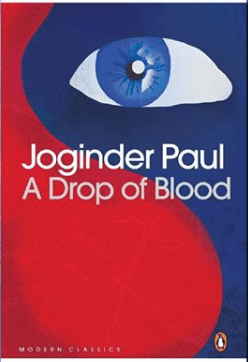
A drop of blood (Ek Boond Lahoo Ka) by Joginder Paul
A DROP OF BLOOD - Joginder Paul
Read - 6 March 2026 to 22 March 2026
Review - 24 March 2026, Updated - 03 May 2026
Finished reading this remarkable novella (160 pages), a very competent English translation of the original in Urdu, titled - “Aik Boond Lahoo Ki”, authored by Joginder Paul (1925 - 2016). It is translated by Snehal Shinghvi, a Professor of English literture at Austin (Texas - USA) who has also translated the works of Premchand and Bhishm Sahni
.
Reading this short book was never contemplated and as a matter of fact, I wasn’t even aware of this novel or it’s author, a shame considering the eminence of Joginder Paul in progressive Urdu literature. One fine morning last week, I found it amongst many other books on my son's reading table while up his room and it caught my fancy as I read through the back cover and the short preface.
Born in Sialkot (now in Pakistan), Joginder Paul was one of the progressive writers from the pre-Partition period and "Aik Boond Lahoo Ki" was published in Karachi in August 1962 as his maiden work. Considered to be one of the greatest Urdu novelists of the 20th century, he was forced to leave the motherland at the age of 22 years and migrate to Nairobi, where he taught English literature. Despite the new country and the employment as professor of English, he continued to hold Urdu close to heart. Being a member of the Progressive Writers’ Association, it was but natural for Joginder Paul to write about class conflict and its impact on the society. I wanted to read this book in Hindi (or Urdu but in Devanagiri script) to get the authentic feel of the pre-partition Punjab. However, to my utter dismay, I found that no Hindi translation or even original Urdu (in Devanagiri script) exits or has ever been published. Urdu and Hindi as languages are close cousins and reading the Urdu version would have been more rewarding compared to the English translation.
The story of “A Drop of Blood” is built around Mohan Karan, the main protagonist, a strikingly handsome young man, a graduate in English literature, and most importntly a jobless orphan who lives with a destitute old woman, Bebe. Unable to find employment, at one of his many failure job interviews, he learns that he can make money by selling his blood to a lucrative blood bank. Karan starts selling his blood to survive and after few months lands up in the house of a rich man, Dr. Bakhtiyar, who is in constant need of the rare blood type of Karan (O - negative). He is ostensibly hired as personal secretary, but his main utility is to provide blood for the ailing old rich man who needs frequent blood transfusions and has been advised a surgery. He starts staying at Dr. Bakhtiyar's palatial house and is able to regularly give handsome money to his adopted mother, Bebe. But he considers selling blood for living loathsome and his soul is torn. Romancing the very modern and progressive daughter of Dr. Bakhtiyar, Zahra, who is obsessed with moving to England is not the employment brief given to him, but he has no choice in this too. Under the garb of free no strings attached affection, he is subjected to exploitation even in love. He had been similarly exploited earlier as well when he got close to his neighbour, Ragini, the wife of a well-heeled old and ailing hakeem. In both the cases, he is promptly discarded at the opportune moment.
The tragic story highlights the binary of two classes, one represented by Karan and the other by Dr. Bakhtiyar, making up the underdog and the exploiter. Blood is an extended metaphor for exploitation in this scathing satire. This metaphor is used to illustrate how the wealthy and corrupt prey off the poor. Inequality as a theme runs throughout the story, not only through the sale of blood, but also through sexual encounters between Karan and wealthier women, the encounters mistakenly perceived by him as love.
A recommended read, I find it expedient to reproduce some of the life lesson passages that appealed to me.
Orphaned children spend their whole lives trying to keep a place open in their hearts, a place that holds the imagined faces of their mothers and fathers. (P 14/15)
Nture has gifted women with a very profound understanding. No matter her age, she always appears innocent and oppressed, but ultimately, at every age, sghe gets the exact outcome that seh desires, and in every situation, she finds a moral justification for her every move. (P 30)
The funny thing about suspicion is that it grows in the mind of the one who is most likely guilty, before it even occurs to others. One can say that the suspicion directed at someone else is, in fact, the echo of one's own terror and guilt. (P 32/33)
When the heart seems to stop at every beat, it was better for it to stop altogether. (P 37)
--we all put a price to our virtue, and by doing so, we become helpless. If we don't, our virtue goes mad from hunger and runs off its own. It is better to sell our virtue to Stan than to watch it starve to death. (P 40/ 41)
The heart of a dejected man is an empty vessel that he uses to give shape to his own feelings, so that sometimes when he feels hopeful for no reason, he will pick it up, despite its emptiness. (P 52).
As long as a man's heart and mind are drunk with laughter, he can find some explanation or another for the selfishness of friends and enemies. Perhaps for this reasson, a person with joyful disposition is usually non-violent and prone to forgivenness. (P 59)
When people are less conscious of their own beauty, they appear even more beautiful. (P 62)
There is definitely one benefit to alcohol, babuji. Once drunk, a man stops caring about his joys and sorrows and, like a naked infant, achieves a pure and loving joy about the world. (P 65)
After the pretence of agreeing to a sacrifice but then being immediately released from that obligation, a human's moral sensibility becomes like a soldier who emerged victorious without a single scratch, puffing out its chest with pride. (P 86)
The hungry are just as deceived by books as they are by the promise of bread. Perhaps, that is why the poor wretches are fated neither for bread nor for education. (P 95)
Human beings have this capacity of deluding ourselves into believing things even when our conscious mind knows it is impossible. (P 101)
Even after more than 70 years of its publication, the story of the book remains relevant valid because the unemployment amongst educated youth remains one of the biggest challenges for the country and because the binary of rich person's life and poor person's life has not changed, rather the gulf has increased further. In the society that we inhabit, a poor person is still selfishly exploited by a rich person, not only physically and materialisticsally, but also emotionally. And this happens in many insisidious ways, at times in garb of affection. This is a disturbing but a truth that cannot be gainsayed and therein lies the importance of the this novella.
Read - 6 March 2026 to 22 March 2026
Review - 24 March 2026, Updated - 03 May 2026
Finished reading this remarkable novella (160 pages), a very competent English translation of the original in Urdu, titled - “Aik Boond Lahoo Ki”, authored by Joginder Paul (1925 - 2016). It is translated by Snehal Shinghvi, a Professor of English literture at Austin (Texas - USA) who has also translated the works of Premchand and Bhishm Sahni
.
Reading this short book was never contemplated and as a matter of fact, I wasn’t even aware of this novel or it’s author, a shame considering the eminence of Joginder Paul in progressive Urdu literature. One fine morning last week, I found it amongst many other books on my son's reading table while up his room and it caught my fancy as I read through the back cover and the short preface.
Born in Sialkot (now in Pakistan), Joginder Paul was one of the progressive writers from the pre-Partition period and "Aik Boond Lahoo Ki" was published in Karachi in August 1962 as his maiden work. Considered to be one of the greatest Urdu novelists of the 20th century, he was forced to leave the motherland at the age of 22 years and migrate to Nairobi, where he taught English literature. Despite the new country and the employment as professor of English, he continued to hold Urdu close to heart. Being a member of the Progressive Writers’ Association, it was but natural for Joginder Paul to write about class conflict and its impact on the society. I wanted to read this book in Hindi (or Urdu but in Devanagiri script) to get the authentic feel of the pre-partition Punjab. However, to my utter dismay, I found that no Hindi translation or even original Urdu (in Devanagiri script) exits or has ever been published. Urdu and Hindi as languages are close cousins and reading the Urdu version would have been more rewarding compared to the English translation.
The story of “A Drop of Blood” is built around Mohan Karan, the main protagonist, a strikingly handsome young man, a graduate in English literature, and most importntly a jobless orphan who lives with a destitute old woman, Bebe. Unable to find employment, at one of his many failure job interviews, he learns that he can make money by selling his blood to a lucrative blood bank. Karan starts selling his blood to survive and after few months lands up in the house of a rich man, Dr. Bakhtiyar, who is in constant need of the rare blood type of Karan (O - negative). He is ostensibly hired as personal secretary, but his main utility is to provide blood for the ailing old rich man who needs frequent blood transfusions and has been advised a surgery. He starts staying at Dr. Bakhtiyar's palatial house and is able to regularly give handsome money to his adopted mother, Bebe. But he considers selling blood for living loathsome and his soul is torn. Romancing the very modern and progressive daughter of Dr. Bakhtiyar, Zahra, who is obsessed with moving to England is not the employment brief given to him, but he has no choice in this too. Under the garb of free no strings attached affection, he is subjected to exploitation even in love. He had been similarly exploited earlier as well when he got close to his neighbour, Ragini, the wife of a well-heeled old and ailing hakeem. In both the cases, he is promptly discarded at the opportune moment.
The tragic story highlights the binary of two classes, one represented by Karan and the other by Dr. Bakhtiyar, making up the underdog and the exploiter. Blood is an extended metaphor for exploitation in this scathing satire. This metaphor is used to illustrate how the wealthy and corrupt prey off the poor. Inequality as a theme runs throughout the story, not only through the sale of blood, but also through sexual encounters between Karan and wealthier women, the encounters mistakenly perceived by him as love.
A recommended read, I find it expedient to reproduce some of the life lesson passages that appealed to me.
Orphaned children spend their whole lives trying to keep a place open in their hearts, a place that holds the imagined faces of their mothers and fathers. (P 14/15)
Nture has gifted women with a very profound understanding. No matter her age, she always appears innocent and oppressed, but ultimately, at every age, sghe gets the exact outcome that seh desires, and in every situation, she finds a moral justification for her every move. (P 30)
The funny thing about suspicion is that it grows in the mind of the one who is most likely guilty, before it even occurs to others. One can say that the suspicion directed at someone else is, in fact, the echo of one's own terror and guilt. (P 32/33)
When the heart seems to stop at every beat, it was better for it to stop altogether. (P 37)
--we all put a price to our virtue, and by doing so, we become helpless. If we don't, our virtue goes mad from hunger and runs off its own. It is better to sell our virtue to Stan than to watch it starve to death. (P 40/ 41)
The heart of a dejected man is an empty vessel that he uses to give shape to his own feelings, so that sometimes when he feels hopeful for no reason, he will pick it up, despite its emptiness. (P 52).
As long as a man's heart and mind are drunk with laughter, he can find some explanation or another for the selfishness of friends and enemies. Perhaps for this reasson, a person with joyful disposition is usually non-violent and prone to forgivenness. (P 59)
When people are less conscious of their own beauty, they appear even more beautiful. (P 62)
There is definitely one benefit to alcohol, babuji. Once drunk, a man stops caring about his joys and sorrows and, like a naked infant, achieves a pure and loving joy about the world. (P 65)
After the pretence of agreeing to a sacrifice but then being immediately released from that obligation, a human's moral sensibility becomes like a soldier who emerged victorious without a single scratch, puffing out its chest with pride. (P 86)
The hungry are just as deceived by books as they are by the promise of bread. Perhaps, that is why the poor wretches are fated neither for bread nor for education. (P 95)
Human beings have this capacity of deluding ourselves into believing things even when our conscious mind knows it is impossible. (P 101)
Even after more than 70 years of its publication, the story of the book remains relevant valid because the unemployment amongst educated youth remains one of the biggest challenges for the country and because the binary of rich person's life and poor person's life has not changed, rather the gulf has increased further. In the society that we inhabit, a poor person is still selfishly exploited by a rich person, not only physically and materialisticsally, but also emotionally. And this happens in many insisidious ways, at times in garb of affection. This is a disturbing but a truth that cannot be gainsayed and therein lies the importance of the this novella.